Understanding Cyberattacks and Effectively Defending Against Them
How attacks originate, who is behind them, which methods are used, and how you can proactively protect your organization.
Explore Protection Measures
How attacks originate, who is behind them, which methods are used, and how you can proactively protect your organization.
Explore Protection MeasuresReading time: 12 minutes
Cyberattacks affect organizations of all sizes: from startups to large enterprises, from hospitals to government agencies. The question is not if, but when, and how well you are prepared.
This page explains what cyberattacks are, how they work, and which protective measures organizations can take. We also recommend our pages on IT security & information security as well as vulnerability management.
ⓘ
Key Takeaway: A cyberattack is a deliberate attempt to compromise IT systems, driven by motives such as extortion, data theft, or political objectives. Consequences range from operational disruptions to insolvency. Prevention is more effective than response.
Cyberattacks are deliberate, malicious attempts to compromise IT infrastructures. Attackers aim to gain an advantage for themselves or a client, at the expense of their victims.
Targeted disruption of critical processes to damage revenue, reputation, or geopolitical stability, often used as leverage or diversion.
The exfiltration of trade secrets, customer data, or intellectual property, which is then used for extortion, espionage, or resale.
Ransomware extortion, the sale of data on criminal marketplaces, and fraudulent transfers are among the most common financially motivated attack objectives.
The consequences range from short-term disruptions to existential threats: significant financial losses, reputational damage, loss of key business partners, regulatory sanctions, and, in extreme cases, insolvency.
In recent years, cyberattacks have affected organizations of all sizes: from startups and Fortune 500 companies to government institutions and critical infrastructure.
Malicious code injected into the widely used Orion IT monitoring software compromised around 100 major organizations, including U.S. federal agencies and Fortune 500 companies. Considered one of the most consequential supply chain attacks in history.
One of the world’s largest food producers was forced to temporarily shut down production and packaging facilities. Ransom payment: USD 11 million. A clear example of the vulnerability of critical supply chains.
A critical vulnerability in the Apache Log4j library affected millions of IT systems worldwide. Exploited for ransomware, cryptomining, and espionage. To this day, one of the most severe known security vulnerabilities.
Vulnerability in the MOVEit MFT software: 2,700+ compromised organizations and 93 million affected individuals across healthcare, finance, and government sectors.
Largest data breach in the U.S. healthcare sector: 192 million affected individuals, total damage of approximately USD 2 billion (including USD 22 million in ransom). Months-long disruption of medical billing across the United States.
Not all attackers pursue the same objectives or have the same capabilities. Understanding the different types of threat actors helps to realistically assess your own risk exposure.
Financially motivated, often operating in highly organized networks. Common methods include ransomware, phishing, and identity theft.
Highly sophisticated actors using zero-day exploits and tailored malware. Often remain undetected within networks for months.
Their objectives include espionage, theft of intellectual property, and sabotage of critical infrastructure, backed by significant state resources.
Employees, contractors, or partners who cause harm either intentionally or unintentionally, ranging from data loss to active sabotage.
Less technically skilled, but pre-built tools enable automated large-scale attacks with very real consequences.
Politically or socially motivated. Their goal is to disrupt systems or publish data in order to spread a message.
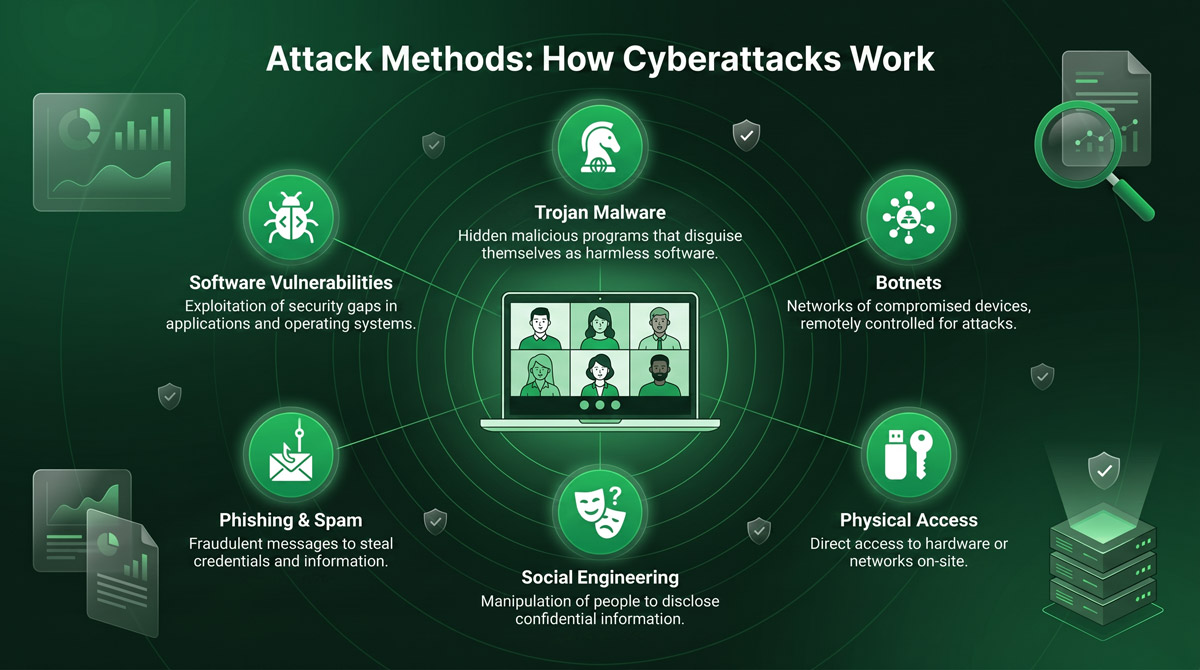
The first step of an attack is initial access-unauthorized entry into a system or network. Attackers often combine technical vulnerabilities with human factors.
Flawed or misconfigured software creates entry points. Attackers systematically scan for known CVEs and zero-day vulnerabilities and develop targeted tools to exploit them.
Malware disguised as legitimate applications or documents grants attackers direct system access once installed—often also providing entry into internal corporate networks.
Compromised devices automatically scan the internet for vulnerable systems or overwhelm targets with DDoS attacks, while masking the attackers’ identity.
Deceptively authentic messages via email, SMS, phone, or QR code target login credentials and payment information, often combined with unpatched vulnerabilities.
Manipulation of human emotions through impersonation, pretexting, baiting, or intimidation. This approach is often more effective than purely technical attacks.
Even brief physical access can have serious consequences: theft of devices, installation of keyloggers, or direct manipulation of IT hardware.
Modern attacks combine technical vulnerabilities with the human factor
The immediate and long-term consequences vary significantly depending on the objective and the methods used.
Encryption of critical data followed by extortion. Even full ransom payment does not guarantee recovery. Backups are the most reliable safeguard.
Stolen data is used for extortion, identity fraud, or sold on criminal marketplaces. Long-term consequences include fines, loss of trust, and reputational damage.
Overloading systems leads to outages and service disruptions. Prolonged interruptions damage business relationships and impact entire supply chains.
Observe reporting obligations: Cyberattacks are criminal offenses. Under NIS 2, GDPR, or sector-specific regulations, organizations may be required to report serious security incidents and preserve evidence.
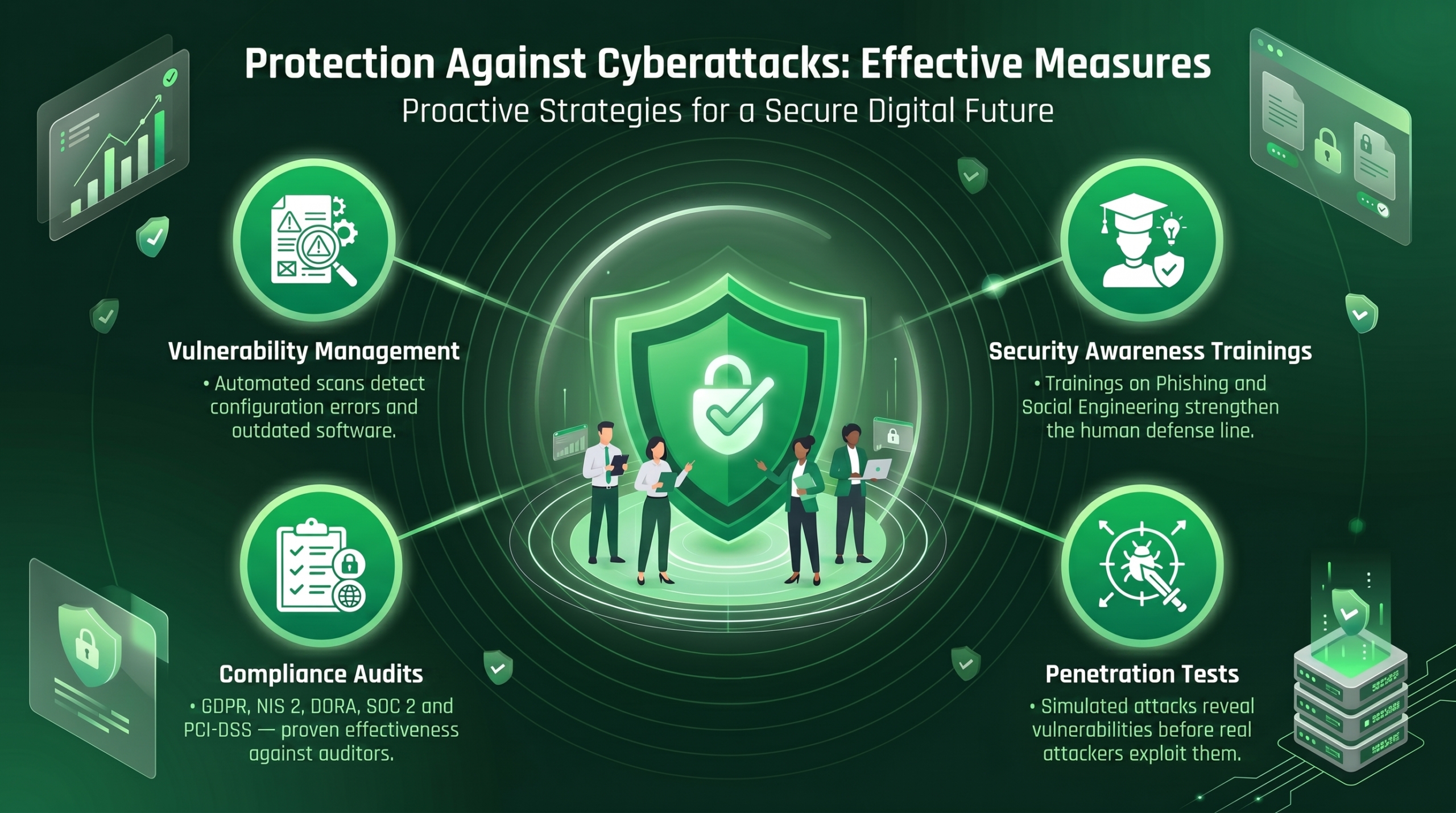
Effective cyber defense requires a multi-layered approach: hardening technologies, training employees, and continuously validating protective measures. The goal is a measurable reduction of the attack surface while maintaining compliance.
Continuous, automated scans of all accessible systems identify misconfigurations, outdated software, and overly permissive access rights. Greenbone provides clear prioritization based on CVSS and measurably reduces the attack surface.
Employees are the first line of defense and at the same time often the weakest link. Regular training on phishing, social engineering, and secure data handling significantly reduces the risk of human error.
GDPR, NIS 2, DORA, HIPAA, SOC 2, and PCI DSS require regular security assessments. Compliance testing demonstrates the actual effectiveness of implemented measures to auditors and regulatory authorities.
Simulated cyberattacks uncover hidden vulnerabilities before real attackers can exploit them. Specializations include networks, web applications, social engineering, and physical access.
Continuous vulnerability analysis: automatically detect risks and remediate them based on priority
A complete, up-to-date overview of all systems and their risk posture, clearly presented for IT teams and management.
Clear focus on the most critical vulnerabilities, based on CVSS scores and contextual data from your specific environment.
Automated reports for management, IT teams, and auditors, compatible with ISO 27001 and BSI IT-Grundschutz.
A documented incident response plan (IRP) significantly reduces the impact of an incident and prevents valuable time from being lost due to organizational uncertainty. Preparation is critical.
Prevention beats response: Proactive security measures, developed with the involvement of executive leadership, management, and IT security teams, provide significantly stronger protection than merely reacting to incidents after they occur.
In less than two minutes, check which security measures you've already implemented and where action is still needed. You'll receive a personal assessment at the end.
Detect vulnerabilities before attackers do.
Find out how Greenbone systematically reduces your attack surface through automated vulnerability management.
Learn more about vulnerability managementWhat is a cyberattack?
A cyberattack is a deliberate, malicious attempt to compromise IT infrastructures, driven by financial motives, data theft, political objectives, or sabotage. The consequences range from operational disruptions and regulatory fines to insolvency.
What types of cyberattacks are there?
The most common types include ransomware (data encryption and extortion), phishing (deception to obtain credentials), DDoS (overloading systems), social engineering (manipulating employees), exploitation of software vulnerabilities, and insider threats.
How can I protect my organization from cyberattacks?
With a multi-layered security approach: continuous vulnerability management, regular security awareness training, consistent patch management, penetration testing, and a documented incident response plan.
Important: Protective measures must be regularly reviewed for effectiveness.
What should I do if my organization is attacked?
Immediately activate the incident response plan, isolate affected systems, secure evidence, and notify the relevant authorities as well as your cyber insurance provider. Comply with legal reporting obligations (NIS 2, GDPR).
Afterward: fully analyze the attack vector and adjust security measures accordingly.
What is ransomware?
Malware that encrypts files and demands a ransom. Even full payment does not guarantee data recovery. Regular, tested backups and proactive vulnerability management are the most reliable protection.
How much does a cyberattack cost?
Costs vary significantly: direct ransom payments (e.g., USD 22 million in the Change Healthcare 2024 case), operational downtime, forensic investigations, legal expenses, and regulatory fines. In addition, there are long-term reputational damages. Total losses in the tens of millions are not uncommon in major incidents.
Would you like to know how well your organization is protected against cyberattacks? In a free initial consultation, our team will show you how Greenbone makes your attack surface visible and measurably reduces it.