• Request IT Security
  • Newsletter
  • Deutsch Deutsch German de
  • English English English en
  • Italiano Italiano Italian it
  • Nederlands Nederlands Dutch nl
Greenbone
  • Products
    • OPENVAS BASIC
      • OPENVAS BASIC: Order
    • OPENVAS SCAN
    • Upcoming Solutions
      • OPENVAS SECURITY INTELLIGENCE
      • OPENVAS AI
    • Solutions for Your Sector
      • Educational Sector
      • Healthcare Sector
      • Public Sector
    • Technology
      • Feed Comparison
      • Product Comparison
        • OPENVAS vs. Nessus
      • Roadmap & Lifecycle
  • Service & Support
    • Technical Support
    • Self-Learning Courses
    • Documents
  • Events
    • Cybersec Europe 2026
    • Webinars
  • Partners
    • MSSP
  • About Greenbone
    • Careers
    • Contact
  • Blog
    • Know-how
      • Attack Vector Timeline
      • Cyberattacks and Defense
      • Cyber Defense Security
      • Cyber Resilience Act
      • Data Security
      • Exposure Management
      • IT and Information Security
      • NIS2 Directive
      • Open Source Vulnerability Management
      • The Vulnerability Timeline
  • Click to open the search input field Click to open the search input field Search
  • Menu Menu
  • Products
    • OPENVAS BASIC
      • OPENVAS BASIC: Order
    • OPENVAS SCAN
    • Upcoming Solutions
      • OPENVAS SECURITY INTELLIGENCE
      • OPENVAS AI
    • Solutions for your sector
      • Educational Sector
      • Healthcare Sector
      • Public Sector
    • Technology
      • Feed Comparison
      • Product Comparison
        • OPENVAS vs. Nessus
      • Roadmap and Lifecycle
    • Request IT Security
  • Service & Support
    • Technical Support
    • Self-Learning Courses
    • Documents
  • Events
    • Cybersec Europe 2026
    • Webinars
  • Partners
    • MSSP
  • About Greenbone
    • Careers
    • Contact
    • Newsletter
  • Our Blog
    • Know-how
      • Attack Vector Timeline
      • Cyberattacks and Defense
      • Cyber Defense Security
      • Cyber Resilience Act
      • Data Security
      • Exposure Management
      • IT and Information Security
      • NIS2 Directive
      • Open Source Vulnerability Management
      • The Vulnerability Timeline
  • German
  • English
  • Italian
  • Dutch

The EU Cyber Resilience Act (CRA)

Among the EU’s security-focused regulations, the CRA stands out as the broadest general security framework and requires action from every manufacturer, importer, and distributor of digital products in the EU.

Get free advice

Reading time: 8 minutes

On this page:

Goals of the CRA Affected products Affected organizations Requirements Timetable & Deadlines How Greenbone helps FAQ No-obligation consultation

What is the EU Cyber Resilience Act?

There is no legal definition of cyber resilience. The term can be defined as a company’s resistance to hacker attacks and preparation for the failure of system-relevant components. o establish a general resilience against cyber attacks within Europe in line with modern IT security and information security the EU has launched several security-focused regulations including the, including the Cyber Resilience Act (CRA), the Directive on the Security of Network and Information Systems (NIS2) and the Digital Operational Resilience Act (DORA).

Among these, the CRA stands out as the most broadly applicable, general security framework. The CRA aims to harden the security of digital products both produced and being sold across the EU. Under the CRA, all digital products must undergo a conformity assessment, and in some cases have the CE marking affixed, before reaching the market.

For more than 15 years, Greenbone has been helping our customers prepare for the highest possible security standard. We see the CRA as an opportunity to provide support and build the strongest possible cyber resilience. The OPENVAS SECURITY INTELLIGENCE platform from Greenbone helps organizations meet the requirements of the CRA.

The EU Cyber Resilience Act: What Are the Goals?

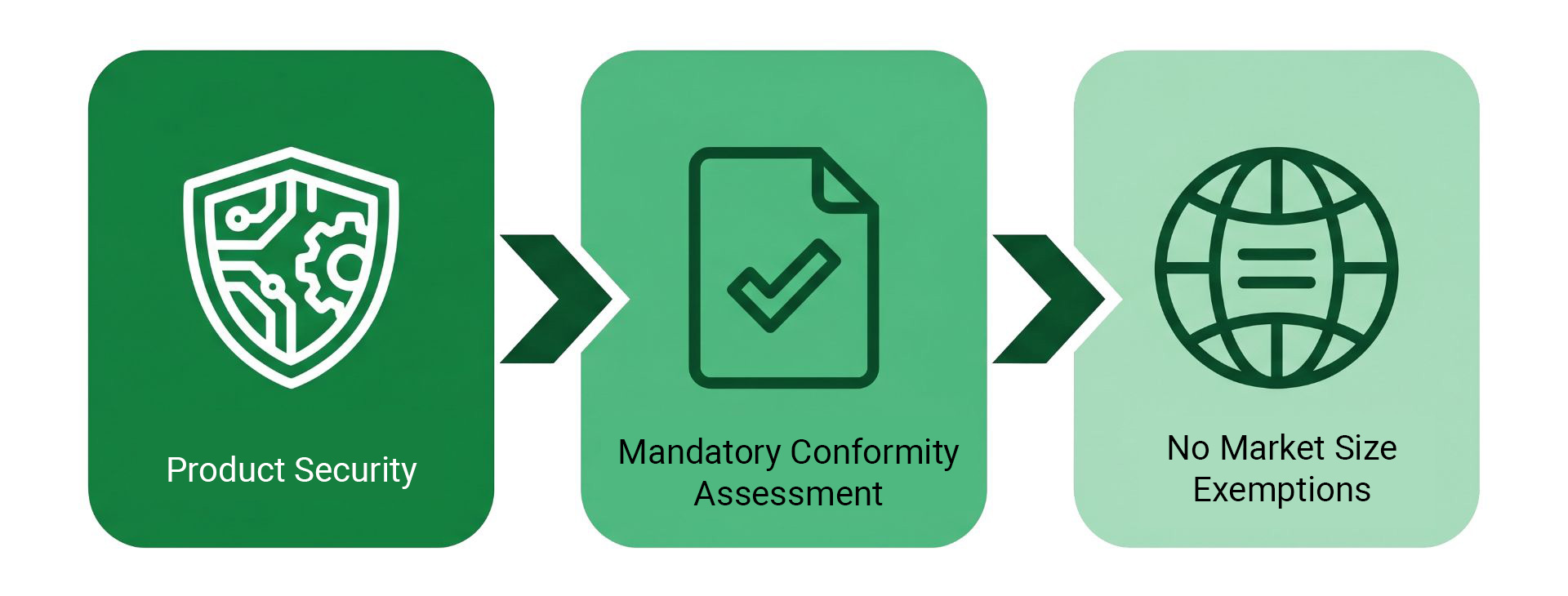
The Cyber Resilience Act is a new set of binding security requirements enacted by the EU Commission. The CRA aims to harden the security of digital products sold across the EU. Under the CRA, all products with digital elements must undergo a conformity assessment, and in some cases have the CE marking affixed before reaching the market.

Harden Digital Product Security

The CRA aims to harden the security of digital products both produced and being sold across the EU, covering the entire product lifecycle from design through end-of-life..

Mandatory Conformity Assessment

All products with digital elements must undergo a conformity assessment and, in some cases, have the CE marking affixed before reaching the market.

No Market-Size Exemptions

The CRA applies equally to all digital products placed on the EU market. There are no market-size-based exemptions for manufacturers headquartered inside or outside the EU.
The Cyber Resilience Act sets out three key requirements for all digital products on the EU market.

The Cyber Resilience Act sets out three key requirements for all digital products on the EU market.

Which Products Are Affected by the Cyber Resilience Act?

The CRA applies to all digital products sold to end consumers within the EU member states. This includes both final products, such as smartphones, and components, such as chips and operating systems. Furthermore, the CRA applies equally to all digital products placed on the EU market, there are no market-size-based exemptions. The CRA also mandates security assessment for IT infrastructure and software used in a company’s own IT operations as part of its “digital supply chain.”

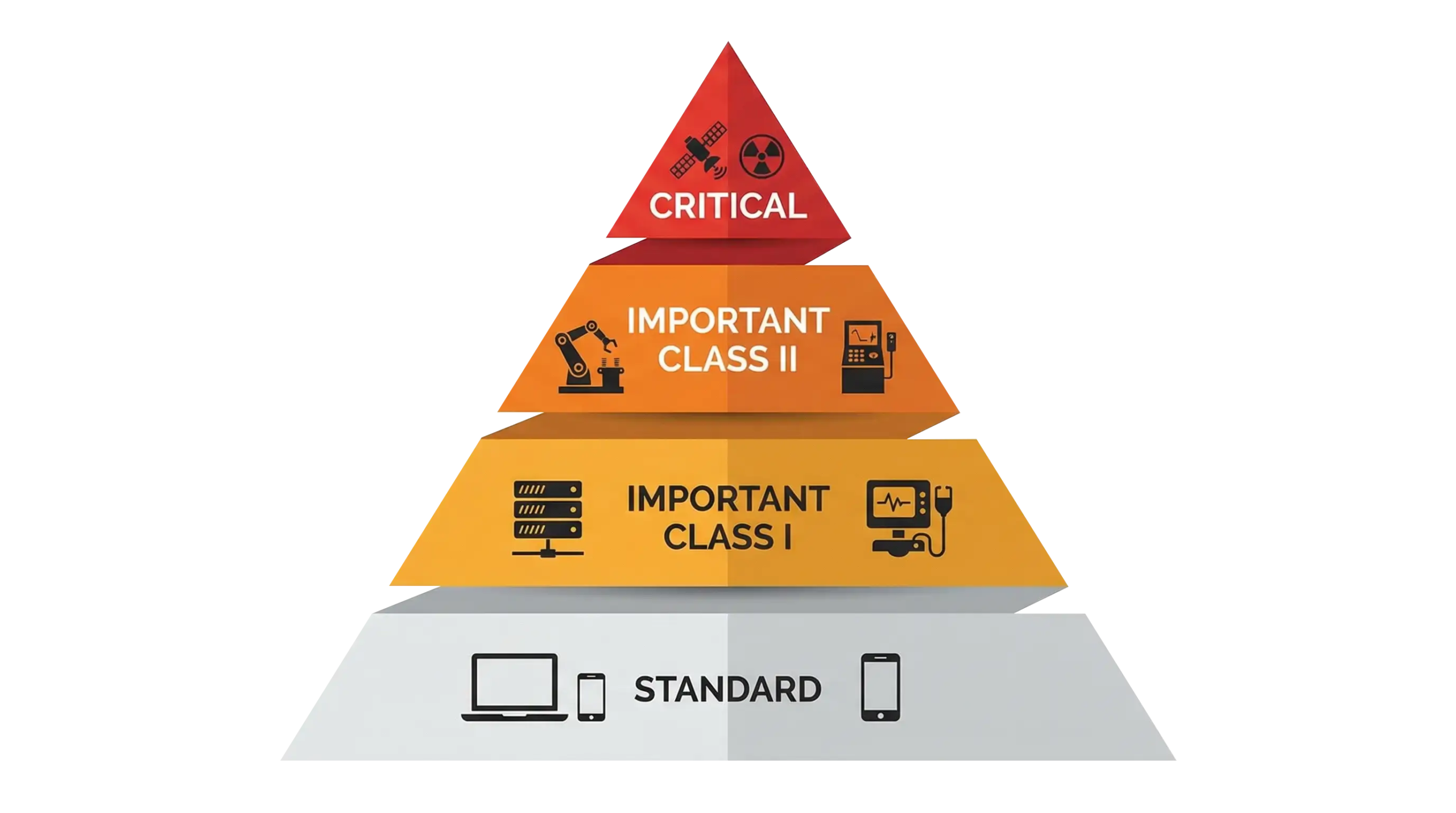
For products being sold on the EU market, the CRA differentiates between digital products according to their criticality to consumer safety, enterprise cyber resilience, and national and regional security.


Four-tier illustration of CRA product classification (Standard, Important Class I, Class II, Critical).

Four-tier illustration of CRA product classification (Standard, Important Class I, Class II, Critical).

The Cyber Resilience Act defines the following product classifications:

01 Standard
Default category of products

General "catch-all" group for digital products distributed in the EU

Examples include memory chips, mobile apps, smart speakers, and computer games among the broad list of all digital products.

02 Class I
Important products with digital elements

Products whose core function justifies stricter assessment rules

This includes IT access management, browsers and operating systems, VPNs, as well as network management and smart home devices.

03 Class II
Important products with digital elements

Products with higher sensitivity within Annex III of EU Regulation 2025/2392

This includes hypervisors and container systems, firewalls and IDS/IPS, as well as tamper-resistant microcontrollers and processors.

04 Critical
Critical products with digital elements

Most security-sensitive classification. Assessment by a certified body is mandatory

This includes smart cards, secure card readers, tachographs, and HSMs, as well as smart meter gateways and cryptographic systems.

What Does This Mean in Practice?

The European Commission estimates that most affected products will fall into the default category and only be subject to self-assessment by the product manufacturer. However, products listed in “Important” and “Critical” categories will be subject to stricter requirements with regard to conformity assessment. Manufacturers of products classified as critical could be required to obtain a special European cyber security certificate and compliance must be indicated by the CE marking on the product, with national post-market monitoring of products for proper implementation.

Category Conformity assessment CE marking Examples
Standard Self-assessment by the manufacturer Required Memory chips, mobile apps, smart speakers, computer games
Class I Stricter rules, third-party assessment possible Required IT access management, browsers, OS, VPNs, network management, smart home devices
Class II Third-party assessment required Required Hypervisors, container runtime, firewalls, IDS/IPS, tamper-resistant microcontrollers
Critical Mandatory certified body; EU cybersecurity certificate possible Required Smartcards, secure card readers, tachographs, HSMs, smart meter gateways

Which Organizations Are Affected by the CRA?

The Cyber Resilience Act defines its scope through the concept of “economic operators.” These include manufacturers, authorized representatives, importers, distributors, as well as all natural or legal persons involved in the manufacture or distribution of digital products in the EU. This affects both producers of end devices such as smartphones and suppliers of individual components such as chips or operating systems. The regulation also applies regardless of where a company is headquartered. Manufacturers outside the EU must also comply if they offer their products on the European market.

The Cyber Resilience Act defines “economic operators” to include:

Manufacturers

Companies that manufacture products with digital elements

Non-EU Manufacturers

Companies outside the EU that distribute digital products in the EU

Authorized representatives

Companies representing manufacturers on the EU market

Importers

Companies that import digital products into the EU

Distributors

Companies that make digital products available in the EU

Other supply chain stakeholders

Companies involved in the manufacture or distribution of digital products in the EU

What Requirements Are Placed on Affected Companies?

The Cyber Resilience Act places a range of responsibilities on economic operators involved in the manufacturing or distribution of digital products in the EU. Broadly, affected entities must take steps to strengthen product security during the entire lifecycle from design to retirement, implement processes for vulnerability handling and reporting, and enable end-user remediation.

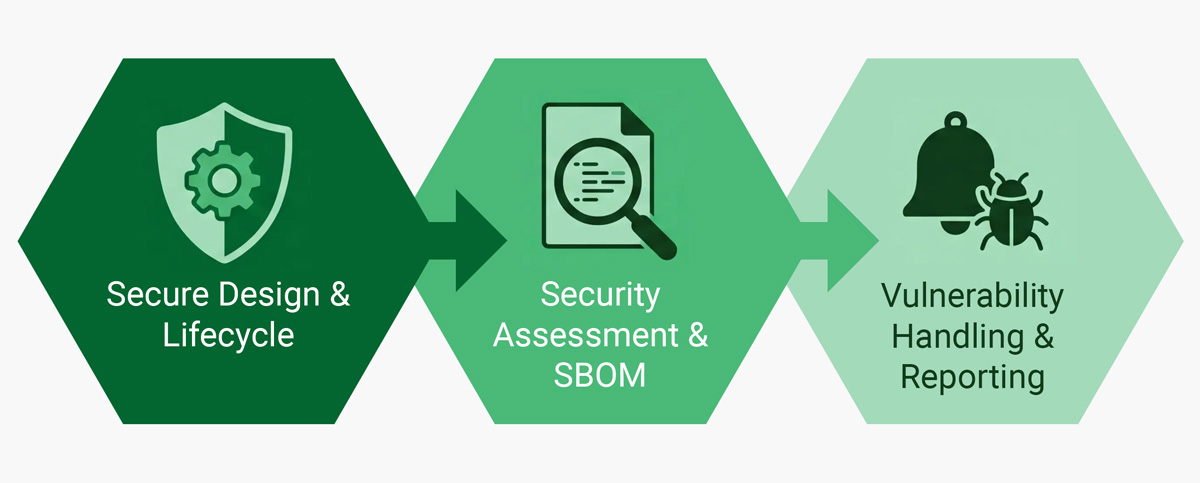
CRA Requirements Overview

Secure product design and lifecycle, security assessments and SBOM, vulnerability handling and reporting obligations.

Secure product design, development, and maintenance across the lifecycle
  • Ensure that products are designed and developed with an appropriate level of cybersecurity
  • Deliver products with a secure-by-default configuration
  • Integrate effective functions for providing security updates for products
  • Maintain product security throughout the entire product lifecycle
Carry out appropriate security assessments for digital products
  • Determine the CRA risk category of each product and apply the appropriate conformity assessment
  • Perform vulnerability scans, including SBOM assessments, to rule out known vulnerabilities
  • Provide a Software Bill of Materials (SBOM) covering a product’s software components
  • Assess the product against the essential security requirements before placing it on the market
  • Create technical documentation and an EU declaration of conformity in accordance with EU 2024/2847 Article 31
  • Apply the CE marking before market launch where required
  • For importers and distributors, verify that the manufacturer has completed all compliance steps
Handling vulnerabilities, reporting, and end-user support
  • Implement processes and infrastructure to document and report product vulnerabilities
  • Report known vulnerabilities and exploits to ENISA within 24 hours
  • Report security incidents to product users, including remediation measures
  • Report identified vulnerabilities in third-party components to the respective suppliers

What happens in case of CRA non-compliance?

Depending on severity, CRA violations may lead to significant penalties.

  • Up to €5 million or 1% of global annual turnover for informational violations
  • Up to €10 million or 2% of global annual turnover for administrative violations
  • Up to €15 million or 2.5% of global annual turnover for serious cybersecurity violations


The Cyber Resilience Act requires regular vulnerability assessments and external audits on a continuous and sustainable basis.

OPENVAS SECURITY INTELLIGENCE supports CRA compliance on premises or in the cloud. Contact us to learn more.

Achieve CRA compliance together

When does the Cyber Resilience Act enter into force?

The CRA was adopted as EU law on October 23, 2024 and officially entered into force on December 10, 2024. Certain CRA compliance deadlines apply in stages and lead to full enforcement on December 11, 2027. The Commission will continuously monitor compliance with the EU’s new cybersecurity rules and may sanction violations where appropriate.

Timeline of the critical phases of CRA implementation:

October 23, 2024
CRA Enacted as EU Law
The Cyber Resilience Act is formally enacted by the EU Commission as binding EU law.
December 10, 2024
Entry Into Force
The CRA officially enters into force. Affected organisations should begin compliance planning immediately.
June 11, 2025
Conformity Assessment Bodies
The provisions set out in EU-2024/2847 Chapter IV to notify conformity assessment bodies enter into force.
September 11, 2026
Vulnerability Reporting Obligations
Obligations set out in EU-2024/2847 Article 14 to report actively exploited vulnerabilities and severe incidents enter into force.
December 11, 2027
Full Enforcement
All remaining CRA requirements enter into full enforcement. The Commission will sanction non-compliance if necessary.
Key deadlines are approaching
The vulnerability reporting obligation from September 2026 requires real-time detection capabilities that must be built well in advance. The OPENVAS SECURITY INTELLIGENCE platform was designed specifically to support these obligations, on premises or in the cloud.
Request a no-obligation consultation

CRA reporting deadlines at a glance

From September 11, 2026, manufacturers must follow strict reporting deadlines for actively exploited vulnerabilities and severe incidents.

24h
Early warning

Initial notification to ENISA and the national CSIRT.

72h
Detailed report

Affected products, vulnerability details and mitigation guidance.

14 days
Final report

Final remediation details after a security update or workaround.

How Greenbone Supports CRA Compliance

Greenbone has helped prepare our customers to achieve the best possible security standard for 15+ years. We view the CRA as an opportunity to provide support and to build the strongest cyber resilience possible. The OPENVAS SECURITY INTELLIGENCE platform helps companies meet the CRA’s requirements on premise or in the cloud.

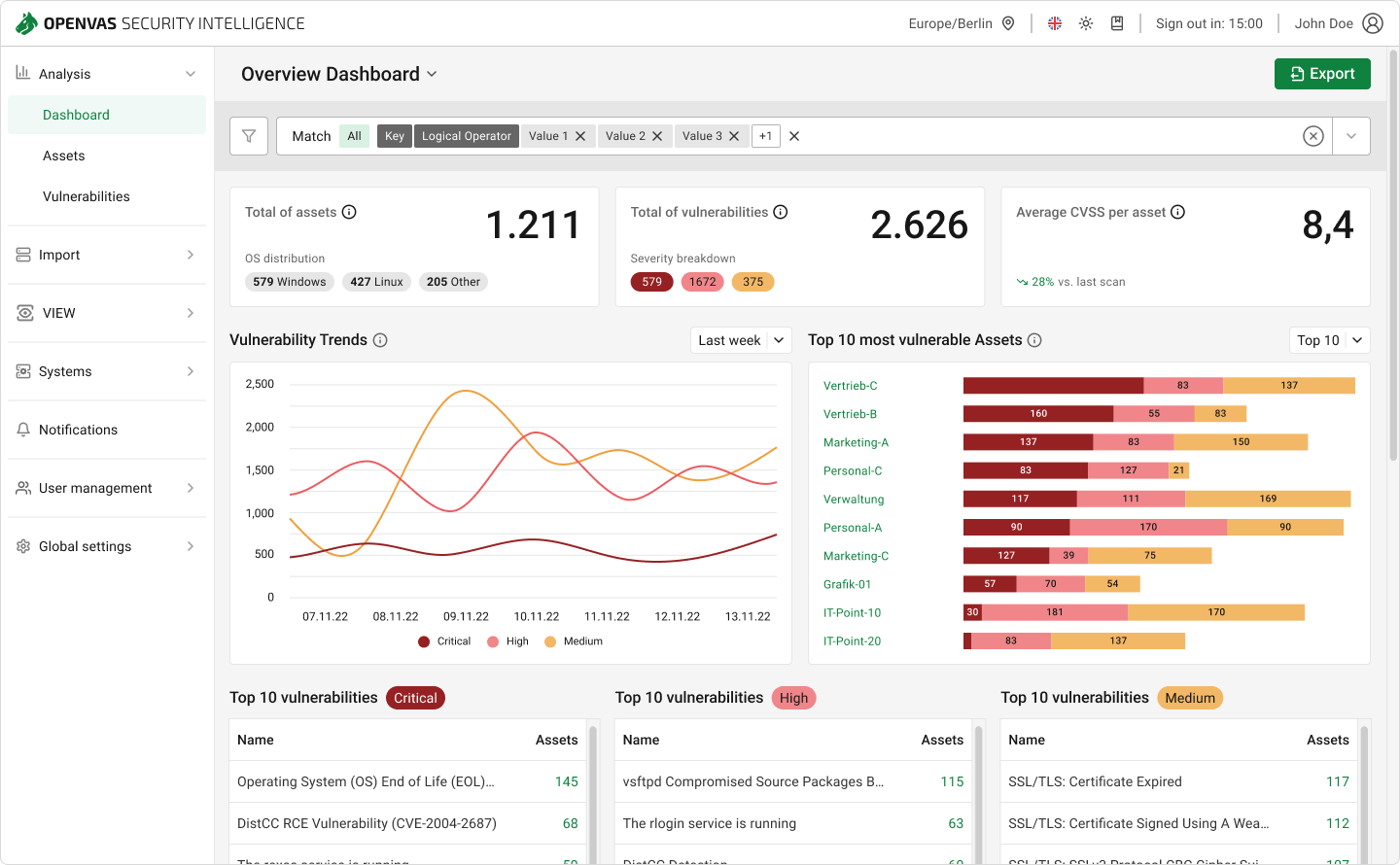
OPENVAS SECURITY INTELLIGENCE Dashboard

OPENVAS SECURITY INTELLIGENCE dashboard with vulnerability scan results, CVSS severity distribution, and asset inventory aligned with CRA reporting requirements.

Continuous Vulnerability Scanning

OPENVAS SECURITY INTELLIGENCE automatically identifies known vulnerabilities across your entire portfolio of digital products and directly supports the CRA requirement for regular vulnerability assessments and SBOM evaluations.

Audit-Ready Compliance Reports

Create the technical documentation required for CRA conformity assessments, including findings prioritized by CVSS, trend analyses, and evidence for the EU declaration of conformity under Article 31.

On Premise or in the Cloud

Deploy OPENVAS SECURITY INTELLIGENCE in your own infrastructure for full data sovereignty or use the cloud solution for rapid deployment. Both options support all CRA compliance workflows.

Real-Time Vulnerability Detection

Detect actively exploited vulnerabilities and severe incidents in real time and support the mandatory CRA reporting of known exploits to ENISA within 24 hours, effective from September 2026.

Software Bill of Materials (SBOM)

Perform SBOM assessments to verify that products are free of known vulnerabilities before being placed on the EU market, and provide component data for downstream customers as required by the CRA.

Digital Supply Chain Visibility

Identify and track vulnerabilities in third-party software components throughout your digital supply chain and meet the requirement to report identified vulnerabilities in third-party components to the respective suppliers.
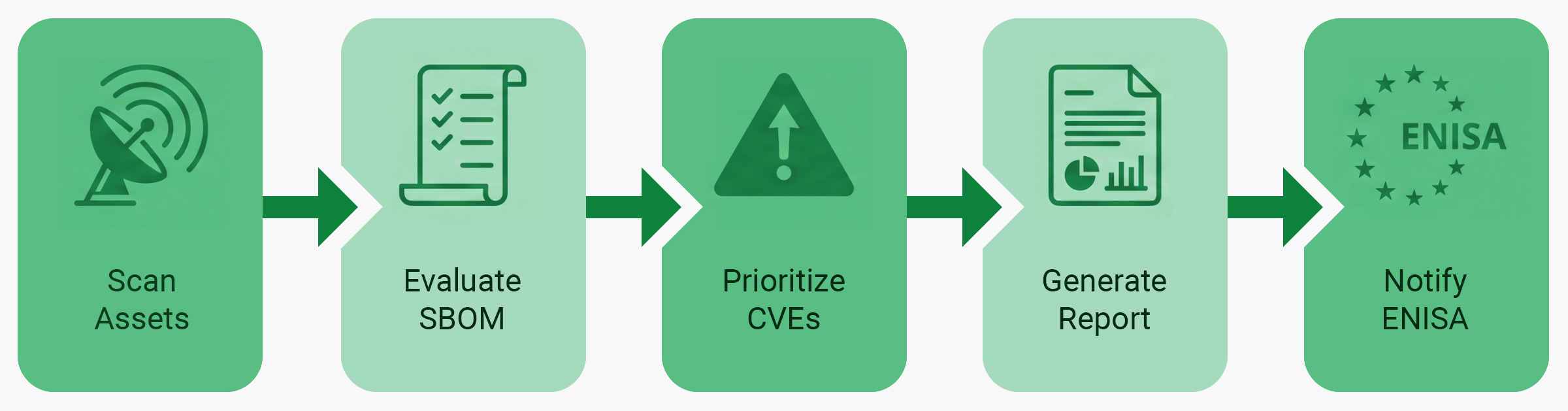
5-step process flow - Cyber Resilience Act

Horizontal process flow: scan assets, assess SBOM, prioritize CVEs, generate report, notify ENISA.

Frequently Asked Questions (FAQ) – Key Questions About the EU Cyber Resilience Act

What is cyber resilience?

There is no legal definition of cyber resilience. The term can be defined as an organization’s ability to withstand cyberattacks and prepare for the failure of critical system components.

What is the EU Cyber Resilience Act (CRA)?

The Cyber Resilience Act is a new set of binding security requirements issued by the European Commission. Its purpose is to strengthen the security of digital products sold throughout the EU. Under the CRA, all products with digital elements must undergo a conformity assessment and, in some cases, bear the CE marking before they can be placed on the market.

Which products are affected by the Cyber Resilience Act?

The Cyber Resilience Act applies to all digital products sold to end users within EU member states. This includes both end products such as smartphones and components such as chips and operating systems. There are no exemptions based on market size. The CRA also requires security assessments for IT infrastructure and software used within a company’s own IT operations as part of the “digital supply chain.”

Does the CRA also apply to manufacturers outside the EU?

Yes. The CRA is not limited to manufacturers headquartered in the EU. Manufacturers outside the EU are subject to the requirements of the CRA if they sell products in the EU. Importers and distributors are also responsible for verifying that the manufacturer has completed the required compliance steps before a product is made available on the EU market.

What is a conformity assessment under the CRA?

A conformity assessment is the procedure by which a manufacturer demonstrates that a product meets the essential security requirements of the CRA. Most products in the standard category are subject only to self-assessment by the manufacturer. Products in the Important Class I, Class II, and Critical categories are subject to stricter requirements. Manufacturers of critical products may be required to obtain a specific European cybersecurity certificate, with conformity indicated by the CE marking.

What vulnerability reporting obligations does the CRA define?

From September 11, 2026, affected manufacturers must report known vulnerabilities and known exploits to ENISA within 24 hours, report security incidents to product users together with the required remediation steps, and report identified vulnerabilities in third-party components to the respective third-party vendors.

What is a Software Bill of Materials (SBOM) and why does the CRA require it?

A Software Bill of Materials (SBOM) is a complete inventory of all software components in a digital product. The CRA requires manufacturers to conduct vulnerability scans, including SBOM assessments, to ensure that products are free of known vulnerabilities and to provide an SBOM covering a product’s software components to downstream customers.

Does the CRA apply to open-source software?

Commercially distributed open-source software can fall under CRA obligations. Non-commercial FOSS contributions are generally excluded.

Open-source software stewards may have lighter obligations, such as maintaining a cybersecurity policy, coordinating vulnerability disclosures and cooperating with market surveillance authorities.

When does the CRA become fully enforceable?

The CRA was adopted as EU law on October 23, 2024, and officially entered into force on December 10, 2024. Compliance deadlines apply in stages: Chapter IV provisions on conformity assessment bodies from June 11, 2025, vulnerability reporting obligations under Article 14 from September 11, 2026, and full enforcement of all remaining requirements from December 11, 2027.

How does the CRA relate to NIS2 and DORA?

The CRA, the Directive on Network and Information Security (NIS), and the Digital Operational Resilience Act (DORA) are all part of the EU’s security-focused regulatory framework. Among these, the CRA stands out as the broadest general security framework, covering all digital products made available on the EU market regardless of industry or company size.

How does Greenbone help with CRA compliance?

For more than 15 years, Greenbone has been helping customers prepare for the highest possible security standard. Greenbone’s OPENVAS SECURITY INTELLIGENCE platform supports organizations with the ongoing vulnerability assessments and external audits required by the CRA, on premises or in the cloud.

Is Your Organization Ready for the Cyber Resilience Act?

Full enforcement begins in December 2027, but the vulnerability reporting obligation takes effect as early as September 2026. Talk to us now and find out how OPENVAS SECURITY INTELLIGENCE supports your CRA compliance program on premises or in the cloud.


Products & Solutions

  • OPENVAS PRODUCTS
  • OPENVAS SECURITY INTELLIGENCE
  • OPENVAS SCAN
  • OPENVAS BASIC
  • OPENVAS FREE
  • OPENVAS AI
ISO9001-EN

Service & Support

  • Technical Support
  • FAQ
  • Documents
  • Warranty
  • Open Source Vulnerability Management
  • Cyber Resilience Act
ISO27001-EN

About us

  • About Greenbone
  • Partners
  • MSSP
  • License information
  • Privacy Statement
  • Terms & Conditions
ISO14001-EN

Contact with us

  • Contact
  • Newsletter
  • Media Contact
  • Careers
  • Security Response
  • Imprint
  • Grounding Page

Community

  • Community Portal
  • Community Forum
© Copyright - Greenbone AG 2020-2026
  • Link to LinkedIn
Scroll to top Scroll to top Scroll to top
Contact
Request IT Security Contact Us Subscribe to Newsletter Follow on LinkedIn