Attack Vectors: The Race Between Exploitation and Closure
Vulnerabilities are often exploited before a patch even exists. With OPENVAS, you detect and close attack vectors before attackers can use them.
Book a Free Consultation
Vulnerabilities are often exploited before a patch even exists. With OPENVAS, you detect and close attack vectors before attackers can use them.
Book a Free ConsultationYou are being targeted, like any organization with networked IT, and there is no way to prevent that entirely. What matters is how fast a vulnerability gets closed before it becomes an actively exploited attack vector. That is a race against time, with clear phases and measurable metrics.
An attack vector is the concrete path an attacker uses to actually exploit a vulnerability in a system, application or network, for example an unpatched software flaw, a misconfiguration or stolen credentials. The term is often confused with attack surface: the attack surface covers every potential entry point into an IT environment, while the attack vector is the specific path an attacker actually takes.
This page looks at a particular angle on attack vectors: their timeline. Every vulnerability that could become an attack vector moves through several phases from creation to closure. How fast these phases pass determines whether a flaw gets exploited or closed in time. For a deeper technical look at the CVE process itself, see our page Vulnerability Timeline – From CVE to Enterprise Feed.
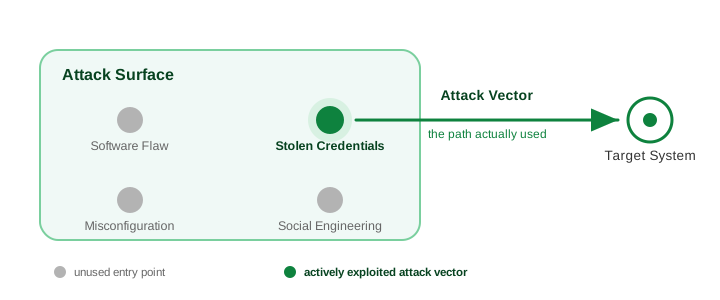
Simplified illustration: not every potential entry point on the attack surface becomes an actively exploited attack vector.
The moment a vulnerability becomes public, a three-leg race begins. The first leg sits entirely with vendors like Greenbone, the other two happen inside your own environment:
Attackers run a strikingly similar three-step process, except that testing and closing are replaced by building and running an exploit. Whoever completes their own legs faster than the other side wins the race:
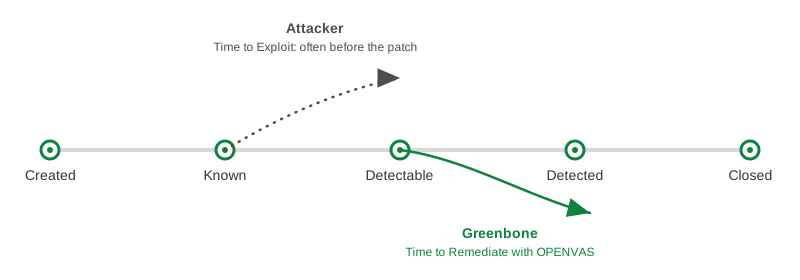
Simplified illustration; actual time spans vary by vulnerability.
Current data shows just how far this race has tilted in attackers’ favor:
Sources: Mandiant M-Trends (2026); Verizon Data Breach Investigations Report (2025); 2025 CVE program analysis.
Every attack vector moves through the same five phases from creation to closure. The overview below shows what happens in each phase and how Greenbone helps shorten it:
| Phase | What Happens | Greenbone's Role |
|---|---|---|
| Creation | A vulnerability enters a product unnoticed, for example through a coding error or an insecure default configuration. At this point, nobody knows about it, including attackers. | Greenbone follows security-focused processes in its own product development and advises customers to do the same in their own software development and third-party module integration. |
| Becomes Known | Someone discovers the vulnerability. In most cases it is reported responsibly, but occasionally an attacker keeps the discovery secret to exploit or sell it. | Greenbone monitors the channels where newly discovered vulnerabilities are discussed and starts building a test early, often before an official CVE entry exists. |
| Detectable | A method exists to reliably prove the vulnerability's presence in an IT environment. | Greenbone publishes one or more vulnerability tests in the OPENVAS feed and keeps updating them as new information becomes available. |
| Detected in Your Environment | Your own scan shows the vulnerability is present in your environment. This is where prioritization and action speed matter most, often slowed by limited resources or a pending vendor patch. | OPENVAS delivers CVSS- and risk-based prioritization directly in the scan report and offers managed services to support remediation. |
| Closed | The vulnerability is fixed or effectively mitigated. The attack vector no longer exists in your environment. | Greenbone's goal is to keep the "becomes known," "detectable" and "detected" phases as short as possible, so you reach this point faster than attackers reach exploitation. |
For a deeper technical look at the CVE process itself, see our page Vulnerability Timeline – From CVE to Enterprise Feed.
Several trends currently give attackers the edge in this race:
Sources: Verizon Data Breach Investigations Report (2025); 2025 CVE program analysis.
OPENVAS was built to shorten exactly the phases that are in your own hands: detection and closure.
A first, concrete plan to win the race against attackers:
What exactly is an attack vector?
An attack vector is the concrete path an attacker uses to exploit a vulnerability, for example an unpatched software flaw, a misconfiguration or stolen credentials.
Is an attack vector the same as a vulnerability?
No. A vulnerability is the technical flaw itself, while an attack vector is the path through which that flaw is actually exploited. Not every vulnerability necessarily becomes an active attack vector.
What does Time to Exploit mean?
Time to Exploit describes the interval between a vulnerability’s disclosure and its first observed exploitation. According to Mandiant’s M-Trends 2026, this now averages -7 days, meaning attackers are often already active before a patch is available.
What does Time to Remediate mean?
Time to Remediate is the time an organization needs to fix a known vulnerability, from detection in its own scan to effective closure.
How quickly does Greenbone publish tests for new vulnerabilities?
Greenbone starts building a test as soon as a vulnerability becomes known, often before an official CVE entry exists. See our page Vulnerability Timeline for details.
Why can the race against attackers never be fully won?
No defense system is one hundred percent secure, and new vulnerabilities are disclosed every day. The goal is therefore not absolute security, but the shortest possible time between disclosure and closure.
How does continuous scanning help against attack vectors?
Only recurring scans reliably show when a new vulnerability appears in your environment. One-off or infrequent checks often leave attack vectors undetected for weeks.
Let’s take a look together at where your time to detect and time to remediate stand today, and which measures would have the biggest impact.