• Request consultation
  • Newsletter
  • Deutsch Deutsch German de
  • English English English en
  • Italiano Italiano Italian it
  • Nederlands Nederlands Dutch nl
Greenbone
  • Products
    • OPENVAS BASIC
      • OPENVAS BASIC: Order
    • OPENVAS SCAN
    • Upcoming Solutions
      • OPENVAS SECURITY INTELLIGENCE
      • OPENVAS AI
    • Solutions for Your Sector
      • Educational Sector
      • Healthcare Sector
      • Public Sector
    • Technology
      • Feed Comparison
      • Product Comparison
        • OPENVAS vs. Nessus
      • Roadmap & Lifecycle
  • Service & Support
    • Professional Services
    • Documents
    • Technical Support
  • Events
    • MSP GLOBAL 2026
    • Webinars
  • Partners
    • MSSP
  • About Greenbone
    • Our History
    • Careers
    • Contact
  • Blog
    • Know-how
      • Attack Vector Timeline
      • Cyberattacks and Defense
      • Cyber Defense Security
      • Cyber Resilience Act
      • Data Security
      • Digital Operational Resilience Act
      • Exposure Management
      • IT and Information Security
      • NIS2 Directive
      • Open Source Vulnerability Management
      • The Vulnerability Timeline
  • Click to open the search input field Click to open the search input field Search
  • Menu Menu
  • Products
    • OPENVAS BASIC
      • OPENVAS BASIC: Order
    • OPENVAS SCAN
    • Upcoming Solutions
      • OPENVAS SECURITY INTELLIGENCE
      • OPENVAS AI
    • Solutions for your sector
      • Educational Sector
      • Healthcare Sector
      • Public Sector
    • Technology
      • Feed Comparison
      • Product Comparison
        • OPENVAS vs. Nessus
      • Roadmap and Lifecycle
    • Request IT Security
  • Service & Support
    • Professional Services
    • Documents
    • Technical Support
  • Events
    • MSP GLOBAL 2026
    • Webinars
  • Partners
    • MSSP
  • About Greenbone
    • Our History
    • Careers
    • Contact
    • Newsletter
  • Our Blog
    • Know-how
      • Attack Vector Timeline
      • Cyberattacks and Defense
      • Cyber Defense Security
      • Cyber Resilience Act
      • Data Security
      • Digital Operational Resilience Act
      • Exposure Management
      • IT and Information Security
      • NIS2 Directive
      • Open Source Vulnerability Management
      • The Vulnerability Timeline
  • German
  • English
  • Italian
  • Dutch
Markus Feilner

Protection of Office Suites: Greenbone Integrates Additional BSI Basic and CIS Guidelines

Blog

The IT-Grundschutz-Compendium of the Federal Office for Information Security (BSI) has, in recent years, provided clear guidelines for users of Microsoft Office. Since April 2024, Greenbone’s enterprise products have integrated tests to verify whether a company is implementing these instructions. The BSI guidelines are aligned with the Center for Internet Security (CIS) guidelines.

In the section “APP:Applications 1.1. Office Products” the BSI specifies the “requirements for the functionality of Office product components.” The goal is to protect the data processed and used by the Office software. While Microsoft Office is likely the primary reference due to its widespread market penetration, the model behind the BSI guidelines aims to apply to any office product “that is locally installed and used to view, edit, or create documents, excluding email applications.”

BSI Guidelines

The module explicitly builds on the requirements of the “APP.6 General Software” component and refers to the modules “APP.5.3 General Email Client,” “APP.4.3 Relational Databases,” and “OPS.2.2 Cloud Usage,” although it expressly does not consider these.

The BSI identifies three main threats to Office suites:

  • Lack of customization of Office products to the institution’s needs
  • Malicious content in Office documents
  • Loss of integrity of Office documents

The components listed in the BSI IT-Grundschutz-Compendium include 16 points, some of which have since been removed. Greenbone has developed several hundred tests, primarily addressing five of the basic requirements, including “Secure opening of documents from external sources” (APP.1.1. A3) and “Use of encryption and digital signatures” listed in APP.1.1. A15. The BSI specifies:

“All documents obtained from external sources MUST be checked for malware before being opened. All file formats deemed problematic and all unnecessary within the institution MUST be banned. If possible, they SHOULD be blocked. Technical measures SHOULD enforce that documents from external sources are checked.”

Regarding encryption, it states: “Data with increased protection requirements SHOULD only be stored or transmitted in encrypted form. Before using an encryption method integrated into an Office product, it SHOULD be checked whether it offers sufficient protection. Additionally, a method SHOULD be used that allows macros and documents to be digitally signed.”

CIS Guidelines Enhance Basic Protection

In addition to the requirements listed in the BSI Basic Protection Manual, the CIS Benchmark from the Center for Internet Security (CIS) for Microsoft Office includes further and more specific suggestions for securing Microsoft products. The CIS guidelines are developed by a community of security experts and represent a consensus-based best practice collection for Microsoft Office.

As one of the first and only vulnerability management providers, Greenbone now offers tests on security-relevant features mentioned in the CIS guidelines, uniting CIS and BSI instructions in numerous, sometimes in-depth tests, such as on ActiveX Control Initialization in Microsoft Office. The Greenbone Vulnerability Management tests whether this switch is set to “enabled”, but also many other settings, for example, whether “Always prevent untrusted Microsoft Query files from opening” is set to “Enabled” among many others.

Many tests focus on external content, integrating macros, and whether and how these external contents are signed, verifiable, and thus trustworthy or not, and whether administrators have done their homework in configuring Microsoft Office. According to the BSI, one of the most significant threats (and the first mentioned) is the lack of adaptation of Office products to the reality and the business processes in the company. Greenbone’s new tests ensure efficient compliance with regulations, making it harder for attackers and malware to establish a foothold and cause damage in the company.

Contact Test Now Buy Here Back to Overview

23. May 2024/by Markus Feilner
https://www.greenbone.net/wp-content/uploads/greenbone-logo-2025.png 0 0 Markus Feilner https://www.greenbone.net/wp-content/uploads/greenbone-logo-2025.png Markus Feilner2024-05-23 16:19:252025-12-18 11:57:44Protection of Office Suites: Greenbone Integrates Additional BSI Basic and CIS Guidelines
Greenbone AG

Potsdam conference for national cyber security 2024

Blog

On 19 and 20 June 2024, it’s all about the big picture: high-ranking IT specialists and decision-makers from politics, business and science will meet in Potsdam to provide an overview of “National Cybersecurity”. One of the biggest, widespread challenges is the rapid development of artificial intelligence (AI). Elmar Geese, CEO of Greenbone, will discuss its influence on IT security with Dr Christoph Bausewein (CrowdStrike), Dr Sven Herpig (Stiftung Neue Verantwortung) and Dr Kim Nguyen (Bundesdruckerei) on the podium.

  • Time: 19 June 2024; 13:45
  • Place: Hasso Plattner Institute, Potsdam, Prof.-Dr.-Helmert-Straße 2-3 (Griebnitzsee campus)
  • Topic: How is artificial intelligence changing the cybersecurity landscape?
  • Moderation: Prof Dr Sandra Wachter, University of Oxford

The Potsdam Conference on National Cybersecurity will take place on 19 and 20 June 2024. Visit us at our stand at the conference!

Registration: https://hpi.de/das-hpi/bewerbung/2024/potsdam-cybersecurity-conference/

Contact Test Now Buy Here Back to Overview

21. May 2024/by Greenbone AG
https://www.greenbone.net/wp-content/uploads/greenbone-logo-2025.png 0 0 Greenbone AG https://www.greenbone.net/wp-content/uploads/greenbone-logo-2025.png Greenbone AG2024-05-21 14:36:012026-02-04 08:58:17Potsdam conference for national cyber security 2024
Joseph Lee

April 2024 Threat Tracking: Record High For Security Vulnerabilities

Blog

April 2024 has compounded another record breaking month for CVE disclosure on top of the last. In this month’s threat tracking report we will investigate several new actively exploited vulnerabilities and quickly review the cyber breach of US R&D giant MITRE. The report will also uncover how end-of-life (EOL) products can have a detrimental impact on an organization’s cybersecurity posture and how to manage the associated risks.

MITRE Exploited Via Ivanti Secure Connect Vulnerabilities

The MITRE Corporation is a not-for-profit organization established in 1958, that operates multiple federally funded research and development centers (FFRDCs) to support the US national defense, cybersecurity, healthcare, aviation, and more. MITRE also maintains several core cybersecurity frameworks such as MITRE ATT&CK, D3FEND, and vulnerability resources including the Common Vulnerabilities and Exposures (CVE) database, the Common Weakness and Enumeration (CWE), and the Common Attack Path Enumeration (CAPEC).

A recent cyber breach of MITRE shows that even the most cyber savvy organizations are not immune to targeted attacks from Advanced Persistent Threats (APTs). Initial access to one of MITRE’s research networks was gained via two Ivanti Connect Secure VPN service vulnerabilities; CVE-2023-46805 (CVSS 8.2) and CVE-2024-21887 (CVSS 9.1). We previously published a full description of these vulnerabilities which can both be detected by Greenbone’s vulnerability tests. After initial access, attackers were able to pivot to adjacent VMware infrastructure [TA0109] using stolen session tokens [T1563] to bypass multi-factor authentication and access admin accounts.

If it can happen to MITRE it can happen to any organization, but patching known actively exploited vulnerabilities is a critical cybersecurity activity that all organizations need to place strong emphasis on.

Operation MidnightEclipse: Exploited PaloAlto Zero Day

On April 10 2024, exploitation of a yet-undiscovered zero-day vulnerability in the GlobalProtect feature of PaloAlto PAN-OS was detected and reported by researchers at cybersecurity firm Volexity. The vulnerability, now tracked as CVE-2024-3400 (CVSS 10), allows unauthenticated remote code execution (RCE) with root privileges, and has been added to the CISA KEV (Known Exploited Vulnerabilities) catalog. The Greenbone enterprise vulnerability feed includes tests to detect CVE-2024-3400 allowing organizations to identify affected assets and plan remediation.

PaloAlto’s Unit42 is tracking subsequent attacks under the name Operation MidnightEclipse and along with Shadowserver Foundation, and GreyNoise, have observed simple probes and full exploitation followed by data exfiltration and installation of remote command and control (C2) tools. Also, several proof of concept (PoC) exploits have been publicly disclosed [1][2] by third parties extending the threat by enabling attacks from low-skilled cyber criminals.

CVE-2024-3400 affects PAN-OS 10.2, PAN-OS 11.0 and PAN-OS 11.1 firewalls configured with GlobalProtect gateway or GlobalProtect portal. Hotfix patches PAN-OS 10.2.9-h1, PAN-OS 11.0.4-h1, PAN-OS 11.1.2-h3 are currently available to remediate affected devices without requiring a restart. A comprehensive guide for remediation is available in the Palo Alto Knowledge Base.

D-Link End-Of-Life Products Exploited Via Hardcoded Credentials

Two critical vulnerabilities have been discovered in NAS devices manufactured by D-Link, labeled as CVE-2024-3272 (CVSS 9.8) and CVE-2024-3273 (CVSS 9.8). The impacted devices include DNS-320L, DNS-325, DNS-327L, and DNS-340L, all of which have reached their end of support product lifecycle. According to D-Link patches will not be provided. Both CVEs are being actively exploited, and a proof of concept (PoC) exploit for CVE-2024-3273 is available online. Globally this affects an estimated 92,000 devices.

Vulnerable devices all contain a default administration account that does not require a password. Attackers can execute commands remotely by sending a specially crafted HTTP GET request to the /cgi-bin/nas_sharing.cgi URI on the NAS web-interface. Combined, the two vulnerabilities pose a severe risk, as they allow root remote code execution (RCE) without authentication on the target device [T1584]. This gives attackers access to potentially sensitive data [TA0010] stored on the compromised NAS device itself, but also a foothold on the victim’s network to attempt lateral penetration [TA0008] to other systems on the network, or launch attacks globally as part of a botnet [T1584.005].

Securing End-Of-Life (EOL) Digital Products

End-of-life (EOL) digital products demand special security considerations due to discontinued vendor support. Here are some defensive tactics for protecting EOL digital products:

  1. Risk Assessment: Conduct regular risk assessments to identify the potential impact of legacy devices on your organization, especially considering that newly disclosed vulnerabilities may not have vendor provided remediation issued.
  2. Vulnerability and Patch Management: Although EOL products may be officially unsupported by their vendors, in some emergency cases, patches are still issued. Vulnerability scanning and patch management help identify new vulnerabilities and allow defenders to seek guidance from the vendor on remediation options.
  3. Isolation and Segmentation: If possible, isolate EOL products from the rest of the network to limit their exposure to potential threats. Segmenting these devices can help contain security breaches and prevent them from affecting other systems.
  4. Harden Configuration and Policies: In some cases, additional policies or security measures such as removing Internet access altogether are appropriate to further mitigate risk.
  5. Update to Supported Products: Update IT infrastructure to replace EOL products with supported alternatives. Transitioning to newer technologies can enhance security posture and reduce the reliance on outdated systems.
  6. Monitoring and Detection: Implement additional monitoring and detection mechanisms to detect any suspicious activity exploitation attempts or attempts at unauthorized access to EOL products. Continuous monitoring can help identify malicious activity promptly and allow appropriate responses.

CVE-2024-4040 CrushFTP VFS Sandbox Escape Vulnerability

CISA has issued an order for all federal US government agencies to patch systems using CrushFTP service due to active exploitation by politically motivated hackers. Tracked as CVE-2024-4040 (CVSS 9.8), the vulnerability allows an unauthenticated attacker to access sensitive data outside of the CrushFTP’s Virtual File System (VFS) and achieve full system compromise. The vulnerability stems from a failure to correctly authorize commands issued via the CrushFTP API [CWE-1336].

CrushFTP is a proprietary file transfer software designed for secure file transfer and file sharing. It supports a wide range of protocols, including FTP, SFTP, FTPS, HTTP, HTTPS, WebDAV, and more. The vulnerability lies in CrushFTP’s Java web-interface API for administering and monitoring the CrushFTP server.

CrushFTP said there is no way to identify a compromised instance from inspecting the application logs. It turned out that CVE-2024-4040 is trivial to exploit and publically available exploits are available, greatly increasing the risk. Greenbone’s Enterprise feed includes a vulnerability test to identify the HTTP header sent by vulnerable versions of CrushFTP.

There are an estimated 6,000 publicly exposed instances of CrushFTP in the US alone and over 7,000 public instances globally. CVE-2024-4040 impacts all versions of the application before 10.7.1 and 11.1.0 on all platforms, and customers should upgrade to a patched version with urgency.

Summary

April 2024 was a record breaking month for CVE disclosure and new cybersecurity challenges, including several high-profile incidents. Ivanti’s Secure Connect VPN was used to gain unauthorized access to MITRE’s development infrastructure leading to internal network attacks.

Various politically motivated threat actors were observed exploiting a zero-day vulnerability in Palo Alto’s PAN-OS now tracked as CVE-2024-3400, and two new critical vulnerabilities in EOL D-Link NAS devices highlight the need for extra security when legacy products must remain in active service. Also, a critical vulnerability in the CrushFTP server was found and quickly added to CISA KEV forcing US government agencies to patch with urgency.

Contact Test Now Buy Here Back to Overview

16. May 2024/by Joseph Lee
https://www.greenbone.net/wp-content/uploads/greenbone-logo-2025.png 0 0 Joseph Lee https://www.greenbone.net/wp-content/uploads/greenbone-logo-2025.png Joseph Lee2024-05-16 16:09:072025-10-02 11:34:38April 2024 Threat Tracking: Record High For Security Vulnerabilities
Greenbone AG

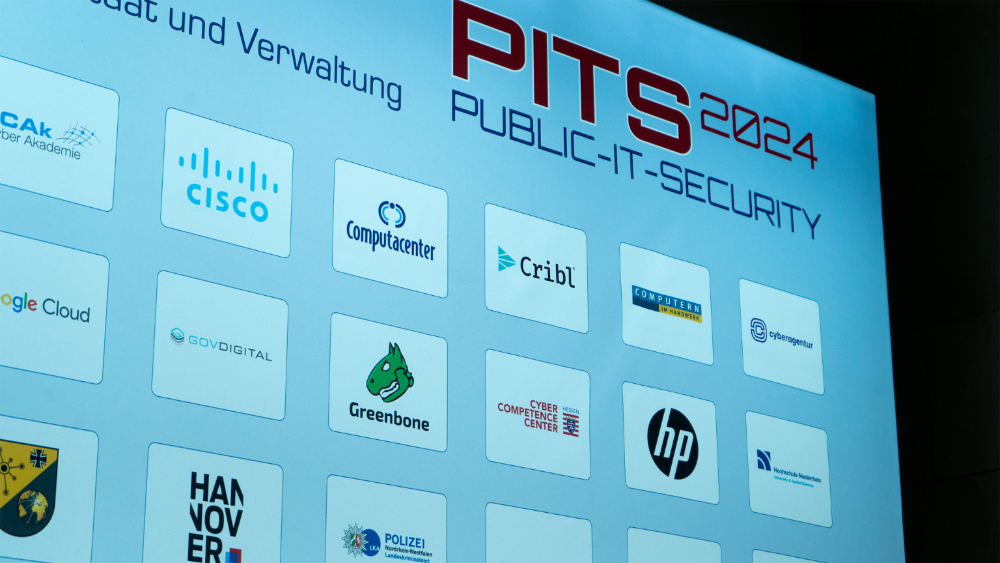
PITS 2024 Public IT Security

Blog

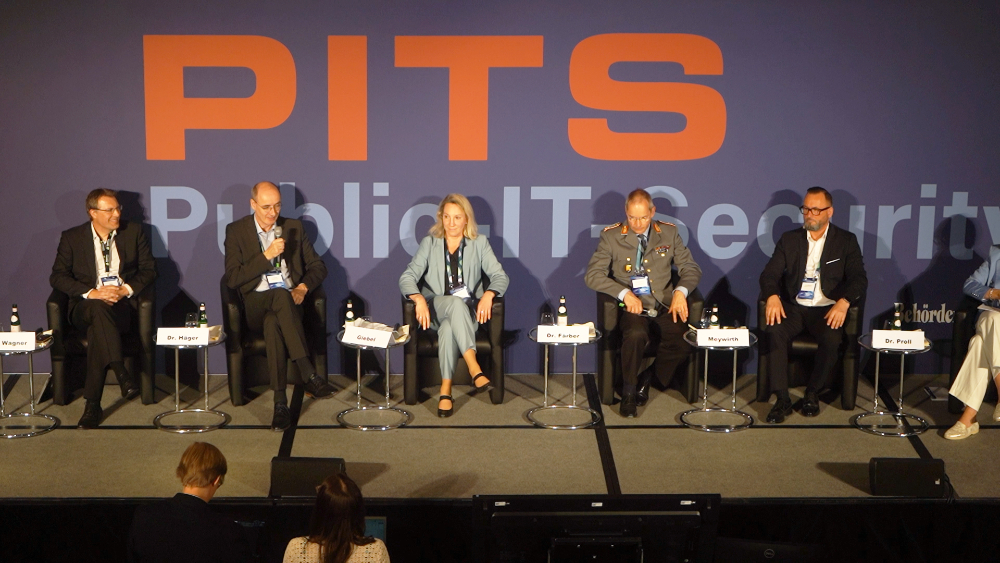
Save the date: The “German Congress for IT and Cyber Security in Government and Administration” (June 12 to 13, 2024) provides information on current trends, strategies and solutions in IT security.

In the main program: “IT support for early crisis detection” (Moderation: Dr. Eva-Charlotte Proll, Editor-in-Chief and Publisher, Behörden Spiegel).

Participants:

  • Dr. Jan-Oliver Wagner, Chief Executive Officer Greenbone
  • Carsten Meywirth, Head of the Cybercrime Division, Federal Criminal Police Office
  • Generalmajor Dr. Michael Färber, Head of Planning and Digitization, Cyber & Information Space Command
  • Katrin Giebel, Branch Manager, VITAKO Bundesverband kommunaler IT-Dienstleister e.V.
  • Dr. Dirk Häger, Head of the Operational Cybersecurity Department, Federal Office for Information Security (BSI)

Where? Berlin, Hotel Adlon Kempinski, Unter den Linden 77
When? 13.06.2024; 9:40 a.m.

Vulnerabilities in IT systems are increasingly being exploited by malicious attackers. You can protect your IT systems with vulnerability management. Visit us in our lounge at stand 44 – we look forward to seeing you!

Registration: https://www.public-it-security.de/anmeldung/

Contact Test Now Buy Here Back to Overview

14. May 2024/by Greenbone AG
https://www.greenbone.net/wp-content/uploads/greenbone-logo-2025.png 0 0 Greenbone AG https://www.greenbone.net/wp-content/uploads/greenbone-logo-2025.png Greenbone AG2024-05-14 16:10:102025-10-02 11:35:06PITS 2024 Public IT Security
Joseph Lee

Springtime for Vulnerabilities

Blog

March 2024 was another eventful month for vulnerabilities and cybersecurity in general. It was the second consecutive month of lapsed Common Vulnerability Exposure (CVE) enrichment putting defenders in a precarious position with reduced risk visibility. The Linux kernel continued its elevated pace of vulnerability disclosures and was commissioned as a new CVE Numbering Authority (CNA). In addition, several critical vulnerabilities were added to CISA’s Known Exploited Vulnerabilities (KEV) list including Microsoft Windows, Fortinet FortiClientEMS, all the major browsers, and enterprise Continuous Integration And Delivery software vendor JetBrains.

Here’s a quick review of March 2024’s most impactful cybersecurity events.

The NIST NVD Disruption

NIST’s National Vulnerability Database (NVD) team largely abandoned CVE Enrichment in February 2024 with no warning. NIST NVD slowed to a CVE enrichment rate of just over 5% during March and it became obvious that the abrupt halt was not just a short-term outage. Disruption of CVE enrichment puts cybersecurity operations around the world at a big disadvantage because the NVD is the largest centralized repository of vulnerability severity information. Without severity enrichment, cybersecurity admins are left with very little information for vulnerability prioritization and risk management decision making.

Experts in the cybersecurity community traded public speculation until the VulnCon & Annual CNA Summit, where NIST’s Tanya Brewer announced that the non-regulatory US government agency would relinquish some aspects of the NVD management to an industry consortium. Brewer did not explain the exact cause for outage, but forecasted several additional goals for NIST NVD moving forward:

  • Allowing more outside parties to submit enrichment data
  • Improving the NVD’s software identification capabilities
  • Adding new types of threat intelligence data such as EPSS and the NIST Bugs Framework
  • Improving the NVD data’s usability and supporting new use cases
  • Automating some aspects of CVE analysis

Plenty Going On “In The Linux Kernel”

A total of 259 CVEs were disclosed in March 2024 with a description that began with: “In the Linux kernel” marking the second most active month ever for Linux vulnerability disclosures. The all time record was set one month prior in February with a total of 279 CVEs issued. March also marked a new milestone for kernel.org, the maintainer of the Linux kernel, as it was inducted as a CVE Numbering Authority (CNA). Kernel.org will now assume the role of assigning and enriching CVEs that impact the Linux kernel. Going forward the kernel.org asserts that CVEs will only be issued for discovered vulnerabilities after a fix is available, and CVEs will only be issued for versions of the Linux kernel that are actively supported.

Multiple High Severity Vulnerabilities In Fortinet Products

Several High severity vulnerabilities in Fortinet FortiOS and FortiClientEMS were disclosed. Of these, CVE-2023-48788 has been added to CISA’s KEV database. The risk imposed by CVE-2023-48788 is further compounded by the existence of a publicly available proof-of-concept (PoC) exploit. While CVE-2023-48788 is notably an SQL Injection [CWE-89] vulnerability, it can be exploited in tandem with the xp_cmdshell function of Microsoft SQL Server for remote code execution (RCE). Even when xp_cmdshell is not enabled by default, researchers have shown that it can be enabled via the SQL Injection weakness.

Greenbone has a network vulnerability test (NVT) that can identify systems affected by CVE-2023-48788, local security checks (LSCs) [1][2] that can identify systems affected by CVE-2023-42790 and CVE-2023-42789, and another LSC to identify systems affected by CVE-2023-36554. A proof-of-concept exploit for CVE-2023-3655 has been posted to GitHub.

  • CVE-2023-48788 (CVSS 9.8 Critical): A SQL Injection vulnerability allowing an attacker to execute unauthorized code or commands via specially crafted packets in Fortinet FortiClientEMS version 7.2.0 through 7.2.2.
  • CVE-2023-42789 (CVSS 9.8 Critical): An out-of-bounds write in Fortinet FortiOS allows an attacker to execute unauthorized code or commands via specially crafted HTTP requests. Affected products include FortiOS 7.4.0 through 7.4.1, 7.2.0 through 7.2.5, 7.0.0 through 7.0.12, 6.4.0 through 6.4.14, 6.2.0 through 6.2.15, FortiProxy 7.4.0, 7.2.0 through 7.2.6, 7.0.0 through 7.0.12, 2.0.0 through 2.0.13.
  • CVE-2023-42790 (CVSS 8.1 High): A stack-based buffer overflow in Fortinet FortiOS allows an attacker to execute unauthorized code or commands via specially crafted HTTP requests. Affected products include FortiOS 7.4.0 through 7.4.1, 7.2.0 through 7.2.5, 7.0.0 through 7.0.12, 6.4.0 through 6.4.14, 6.2.0 through 6.2.15, FortiProxy 7.4.0, 7.2.0 through 7.2.6, 7.0.0 through 7.0.12, 2.0.0 through 2.0.13.
  • CVE-2023-36554 (CVSS 9.8 Critical): FortiManager is prone to an improper access control vulnerability in backup and restore features that can allow attackers to execute unauthorized code or commands via specially crafted HTTP requests. Affected products are FortiManager version 7.4.0, version 7.2.0 through 7.2.3, version 7.0.0 through 7.0.10, version 6.4.0 through 6.4.13 and 6.2, all versions.

Zero Days In All Major Browsers

Pwn2Own, an exciting hacking competition took place at CanSecWest security conference on March 20th – 22nd. At this year’s event, 29 distinct zero-days were discovered and over one million dollars in prize money was awarded to security researchers. Independent entrant Manfred Paul earned a total of $202,500 including $100,000 for two zero day sandbox escape vulnerabilities in Mozilla Firefox. Mozilla quickly issued updates to Firefox with version 124.0.1.

Manfred Paul also achieved remote code execution (RCE) in Apple’s Safari by combining Pointer Authentication Code (PAC) [D3-PAN] bypass and integer underflow [CWE-191] zero-days. PACs in Apple’s operating systems are cryptographic signatures for verifying the integrity of pointers to prevent the exploitation of memory corruption bugs. PAC has been bypassed before for RCE in Safari. Manfred defeated Google Chrome and Microsoft Edge via an Improper Validation of Specified Quantity in Input [CWE-1284] vulnerability to complete the browser exploit trifecta.

The fact all major browsers were breached underscores the high risk of visiting untrusted Internet sites and the overall lack of security provided by major browser vendors. Greenbone includes tests to identify vulnerable versions of Firefox and Chrome.

  • CVE-2024-29943 (CVSS 10 Critical): An attacker was able to exploit Firefox via an out-of-bounds read or write on a JavaScript object by fooling range-based bounds check elimination. This vulnerability affects versions of Firefox before 124.0.1.
  • CVE-2024-29944 (CVSS 10 Critical): Firefox incorrectly handled Message Manager listeners allowing an attacker to inject an event handler into a privileged object to execute arbitrary code.
  • CVE-2024-2887 (High Severity): A type confusion [CWE-843] vulnerability in the Chromium browser’s implementation of WebAssembly (Wasm).

New Actively Exploited Microsoft Vulnerabilities

Microsoft’s March 2024 security advisory included a total of 61 vulnerabilities impacting many products. The Windows kernel had the most CVEs disclosed with a total of eight, five of which are rated high severity. Microsoft WDAC OLE DB provider for SQL, Windows ODBC Driver, SQL Server, and Microsoft WDAC ODBC Driver combined to account for ten high severity CVEs. There are no workarounds for any vulnerabilities in the group meaning that updates must be applied to all affected products. Greenbone includes vulnerability tests to detect the newly disclosed vulnerabilities from Microsoft’s March 2024 security advisory.

Microsoft has so far tagged six its new March 2024 vulnerabilities as “Exploitation More Likely”, while two new vulnerabilities affecting Microsoft products were added to the CISA KEV list; CVE-2023-29360 (CVSS 8.4 High) affecting Microsoft Streaming Service and CVE-2024-21338 (CVSS 7.8 High) published in 2023 were assigned actively exploited status in March.

CVE-2024-27198: Critical Severity CVE In JetBrains TeamCity

TeamCity is a popular continuous integration and continuous delivery (CI/CD) server developed by JetBrains, the same company behind other widely-used development tools like IntelliJ IDEA, the leading Kotlin Integrated Development Environment (IDE), and PyCharm, an IDE for Python. TeamCity is designed to help software development teams automate and streamline their build, test, and deployment processes and competes with other CI/CD platforms such as Jenkins, GitLab CI/CD, Travis CI, and Azure DevOps, among others. TeamCity is estimated to hold almost 6% of the total Continuous Integration And Delivery market share and ranks third overall, while according to JetBrains, over 15.9 million developers use their products, including 90 of the Fortune Global Top 100 companies.

Given JetBrains market position, a critical severity vulnerability in one of their products will quickly attract the attention of threat actors. Within three days of CVE-2024-27198 being published it was added to the CISA KEV catalog. Greenbone Enterprise vulnerability feed includes tests to identify affected products including a version check and an active check that sends a crafted HTTP GET request and analyzes the response.

When combined, CVE-2024-27198 (CVSS 9.8 Critical) and CVE-2024-27199 allow an attacker to bypass authentication using an alternative path or channel [CWE-288] to read protected files including those outside of the restricted directory [CWE-23] and perform limited admin actions.

Summary

March 2024 was another fever-pitched month for software vulnerabilities due to the NIST NVD outage and active exploitation of several vulnerabilities in enterprise and consumer software products. On the bright side, several zero-day vulnerabilities impacting all major browsers were identified and patched.

However, the fact that a single researcher was able to so quickly exploit all major browsers is serious wake-up call for all organizations since the browser plays such a fundamental role in modern enterprise operations. Vulnerability management remains a core element in cybersecurity strategy, and regularly scanning IT infrastructure for vulnerabilities ensures that the latest threats can be identified for remediation – closing the gaps that attackers seek to exploits for access to critical systems and data.

Contact Test Now Buy Here Back to Overview

15. April 2024/by Joseph Lee
https://www.greenbone.net/wp-content/uploads/greenbone-logo-2025.png 0 0 Joseph Lee https://www.greenbone.net/wp-content/uploads/greenbone-logo-2025.png Joseph Lee2024-04-15 13:58:352025-12-16 14:23:11Springtime for Vulnerabilities
Markus Feilner

Municipalities, authorities and companies under pressure: serious attacks on the rise, NIS2 becomes mandatory

Blog

After experts noticed a rapid increase in cyberattacks on local authorities and government agencies in 2023, the horror stories don’t stop in 2024. The pressure to act is enormous, as the EU’s NIS2 Directive will come into force in October and makes risk and vulnerability management mandatory.

“The threat level is higher than ever,” said Claudia Plattner, President of the German Federal Office for Information Security (BSI), at Bitkom in early March. The question is not whether an attack will be successful, but only when. The BSI’s annual reports, for example the most recent report from 2023, also speak volumes in this regard. However, according to Plattner, it is striking how often local authorities, hospitals and other public institutions are at the centre of attacks. There is “not a problem with measures but with implementation in companies and authorities”, said Plattner. One thing is clear: vulnerability management such as Greenbone’s can provide protection and help to avoid the worst.

US authorities infiltrated by Chinese hackers

In view of the numerous serious security incidents, vulnerability management is becoming more important every year. Almost 70 new security vulnerabilities have been added every day in recent months. Some of them opened the door to attackers deep inside US authorities, as reported in the Greenbone Enterprise Blog:

  • Ivanti
  • Fortinet
  • Juniper
  • Atlassian
  • Microsoft

According to the media, US authorities have been infiltrated by Chinese hacker groups such as the probably state-sponsored “Volt Typhoon” for years via serious security gaps. The fact that Volt Typhoon and similar groups are a major problem was even confirmed by Microsoft itself in a blog back in May 2023. But that’s not all: German media reported that Volt Typhoon is taking advantage of the abundant vulnerabilities in VPN gateways and routers from FortiNet, Ivanti, Netgear, Citrix and Cisco. These are currently considered to be particularly vulnerable.

The fact that the quasi-monopolist in Office, groupware, operating systems and various cloud services also had to admit in 2023 that it had the master key for large parts of its Microsoft cloud let stolen destroyed trust in the Redmond software manufacturer in many places. Anyone who has this key doesn’t need a backdoor for Microsoft systems any longer. Chinese hackers are also suspected in this case.

Software manufacturers and suppliers

The supply chain for software manufacturers has been under particular scrutiny by manufacturers and users not only since log4j or the European Cyber Resilience Act. The recent example of the attack on the XZ compression algorithm in Linux also shows the vulnerability of manufacturers. In the case of the “#xzbackdoor”, a combination of pure coincidence and the activities of Andres Freund, a German developer of open source software for Microsoft with a strong focus on performance, prevented the worst from happening.

An abyss opened up here: It was only thanks to open source development and a joint effort by the community that it came to light that actors had been using changing fake names with various accounts for years with a high level of criminal energy and with methods that would otherwise be more likely to be used by secret services. With little or no user history, they used sophisticated social scams, exploited the notorious overload of operators and gained the trust of freelance developers. This enabled them to introduce malicious code into software almost unnoticed. In the end, it was only thanks to Freund’s interest in performance that the attack was discovered and the attempt to insert a backdoor into a tool failed.

US officials also see authorities and institutions as being particularly threatened in this case, even if the attack appears to be rather untargeted and designed for mass use. The issue is complex and far from over, let alone fully understood. One thing is certain: the usernames of the accounts used by the attackers were deliberately falsified. We will continue to report on this in the Greenbone blog.

European legislators react

Vulnerability management cannot prevent such attacks, but it provides indispensable services by proactively warning and alerting administrators as soon as such an attack becomes known – usually before an attacker has been able to compromise systems. In view of all the difficulties and dramatic incidents, it is not surprising that legislators have also recognised the magnitude of the problem and are declaring vulnerability management to be standard and best practice in more and more scenarios.

Laws and regulations such as the EU’s new NIS2 directive make the use of vulnerability management mandatory, including in the software supply chain. Even if NIS2 only actually applies to around 180,000 organisations and companies in the critical infrastructure (KRITIS) or “particularly important” or “significant” companies in Europe, the regulations are fundamentally sensible – and will be mandatory from October. The EU Commission emphasises that “operators of essential services” must “take appropriate security measures and inform the competent national authorities of serious incidents”. Important providers of digital services such as search engines, cloud computing services and online marketplaces must fulfil the security and notification requirements of the directive.”

Mandatory from October: A “minimum set of cyber security measures”

The “Directive on measures for a high common level of cybersecurity across the Union (NIS2)” forces companies in the European Union to “implement a benchmark of minimum cybersecurity measures”, including risk management, training, policies and procedures, also and especially in cooperation with software suppliers. In Germany, the federal states are to define the exact implementation of the NIS2 regulations.

Do you have any questions about NIS2, the Cyber Resilience Act (CRA), vulnerability management in general or the security incidents described? Write to us! We look forward to working with you to find the right compliance solution and give your IT infrastructure the protection it needs in the face of today’s serious attacks.

To make our ecological progress even more sustainable, we keep up to date with regular internal training courses on energy efficiency. In this way, we are helping to make the world even “greener” outside of Greenbone.

Contact Test Now Buy Here Back to Overview

11. April 2024/by Markus Feilner
https://www.greenbone.net/wp-content/uploads/greenbone-logo-2025.png 0 0 Markus Feilner https://www.greenbone.net/wp-content/uploads/greenbone-logo-2025.png Markus Feilner2024-04-11 15:24:192025-10-02 10:03:54Municipalities, authorities and companies under pressure: serious attacks on the rise, NIS2 becomes mandatory
Greenbone AG

Greenbone All in Green: ISO 14001 Certification

Blog

It doesn’t get any greener? Not at all! We have just completed certification of our environmental management system in accordance with ISO 14001. And we have realised: There is always room for getting “greener” – you just have to be committed and willing to drive this commitment forward in measurable progress.

Greenbone passes ISO 14001 Certification.

The international standard ISO 14001 defines requirements that companies can use to achieve environmental goals and fulfil legal obligations. Because the environmental niche is different for every organisation, the standard does not specify absolute values and targets, but it does emphasise integration into quality management, C-level responsibility for environmental management and the elimination of ambiguity regarding environmental targets.

Targets, objectives, key figures: A dry framework for green growth

The current German version of the standard, DIN EN ISO 14001:2015, places particular emphasis on “environmental performance improvement” and its measurement using appropriate indicators. The ecological objectives thus relate to the upstream and downstream environmental impact of products and services as well as the consideration of opportunities and risks in day-to-day business. The whole process is to be set up as part of a continuous improvement process (CIP) so that the effects of each new measure can be monitored and adapted accordingly. With this certification, we are proud to be able to announce another important step towards a company that is not only “green” on the outside, in the company logo, but also on the inside.

Back in autumn 2023, when the “Environmental Management System” was introduced, it was clear to us: we may not be able to save the world, but every step in this direction is important to us! So, step by step, we started by collecting all aspects that could have an impact on the environment. After ranking the factors and prioritising them, eleven areas emerged in which Greenbone can become ecologically effective and active: Starting with electricity consumption, cooling servers, heating offices and dispatching goods, through to waste separation and the energy efficiency of our appliances.

And again and again: measure…

As a company that emphasises the realisation and clear presentation of objectives, Greenbone is already certified according to ISO 9001:2015 (quality management) and ISO 27001:2017 (information security) as well as within the framework of TISAX for the Information Security Management System (ISMS). For ISO 14001, we have concretised our objectives in clearly defined key performance indicators (KPIs) in order to make them available for subsequent measurements. This allows us to readjust existing measures and introduce further improvements. What initially sounds dry is already bearing its first “green” fruits

  • Our electricity has been supplied entirely from renewable energy sources since the company was founded. Total consumption – including clients and servers – is set to be reduced by a further 3% in the near future.
  • Whenever we purchase new equipment, we pay particular attention to sustainability and energy efficiency.
  • Since 2020, we have only used electric cars as company vehicles.
  • We have switched to digital payroll accounting.
  • The server room is regularly checked for potential savings.
  • We also prioritise environmental protection on a small scale: Waste is only collected centrally and packaging material is reused as a matter of principle.

To make our ecological progress even more sustainable, we keep up to date with regular internal training courses on energy efficiency. In this way, we are helping to make the world even “greener” outside of Greenbone.

Contact Test Now Buy Here Back to Overview


27. March 2024/by Greenbone AG
https://www.greenbone.net/wp-content/uploads/greenbone-logo-2025.png 0 0 Greenbone AG https://www.greenbone.net/wp-content/uploads/greenbone-logo-2025.png Greenbone AG2024-03-27 15:55:022026-02-04 08:58:24Greenbone All in Green: ISO 14001 Certification
Markus Feilner

Chinese hackers and Fortinet vulnerabilities: Warnings from US government

Blog

For several years in a row, the Californian manufacturer Fortinet has been in the public focus due to serious security problems. Known for its secure firewall, VPN and intrusion detection devices, the cyber security expert was again forced to announce several highly critical security vulnerabilities in February 2024.

Staying informed and applying patches promptly is what companies need to proactively protect themselves against such attacks. Products such as Greenbone’s Enterprise Appliances play a central role in this and are meant to help admins. All the vulnerabilities mentioned in this blog post are covered by tests from the Greenbone Enterprise Feed: active procedures check whether the exploit is possible, and versioning tests will deliver results about the success of patch management.

87,000 passwords: Fortinet wins “Vulnerability of the Year 2022”

In 2019, CVE-2018-13379 (CVSS 9.8) allowed over 87,000 passwords for the Fortinet VPN to be read from the devices. In the following years, this vulnerability was exploited so successfully that in 2022 it was awarded the dubious title of “most exploited vulnerability of 2022“. The US authorities reacted and urged all of their clients to be more aware of the problem: Both U.S. Cybersecurity and Infrastructure Security Agency (CISA), the National Security Agency (NSA) and the Federal Bureau of Investigation (FBI) warned about the fact that many customers did not apply patches promptly. Again, lack of foresight turned out to be one of the main reasons. Patching, so the agencies, would have prevented many of successful attacks.

2023: Unwanted guests in critical networks

What makes it worse, is the fact that Fortinet devices are mostly being used in security-critical areas. Unpatched and equipped with serious vulnerabilities, such devices have become the focus of attackers in recent years, especially by state actors. In 2023, for example, Chinese hacker groups successfully infiltrated Dutch military networks via a vulnerability in the FortiOS SSL VPN from December 2022 that actually had already been patched for a while (CVE-2022-42475, CVSS 9.3).

Even though the network was only used for research and development according to the Military Intelligence and Security Service (MIVD), the attacks published at the beginning of February made it clear how easy it is for attackers to penetrate even highly protected networks. Even worse so, the corresponding backdoor “Coathanger” allows attackers to gain permanent access to devices once they have been hacked, all thanks to the vulnerability 2022-42475, which allows the execution of arbitrary code.

February 2024: Warnings of further vulnerabilities, maximum severity

Unfortunately, the story does not end here: Fortinet also had to admit another serious vulnerability, beginning of February 2024: CVE-2024-21762 (CVSS score: 9.6) allows unauthorized attackers to execute arbitrary code via specially adapted requests. A long list of versions of the Fortinet operating system FortiOS and FortiProxy are affected. The manufacturer advises upgrading or deactivating the SSL VPN and warns of both the severity of the vulnerability and the fact that it is already being massively exploited by attackers.

Fortinet seemed to have some organizational issues, too. Just as bad as the above sounded CVE-2024-23108 and CVE-2024-23109, published just a few days later, which also allow unauthenticated attackers to execute arbitrary code. However, these CVEs have to be taken with a grain of salt: The fact that two CVEs from the same manufacturer received a 10.0 on the threat severity scale on the same day is probably unique and raised some experts’ eyebrows. Apart from that, the confusing communication from the vendor was not really likely to establish or further trust, similarly to the strange story of toothbrush-based attacks told by a Fortinet employee, reaching the mass media at the same time.

Fatal combination – vulnerability management can help

As always, Fortinet published patches promptly, but customers also have to install them. Again, the combination of serious security vulnerabilities, lack of awareness and the absence of patches showed its full impact: Only a few days later the US government pushed out another advisory from CISA, NSA and FBI about Volt Typhoon, a Chinese state hacker group. The US government had evidence that these attackers have permanently nested in critical infrastructure of US authorities for many years via such vulnerabilities – the associated risks should not be underestimated, according to the warning.

The security by design required there also includes the constant monitoring of one’s own servers, computers and installations with vulnerability tests such as those of Greenbone Enterprise Appliances. Those who constantly monitor their networks (not just Fortinet devices) with the vulnerability tests of a modern vulnerability scanner can inform their administrators as quickly as possible if known CVEs in an infrastructure are waiting for patches, reducing the attack surface.

Contact Test Now Buy Here Back to Overview

15. March 2024/by Markus Feilner
https://www.greenbone.net/wp-content/uploads/greenbone-logo-2025.png 0 0 Markus Feilner https://www.greenbone.net/wp-content/uploads/greenbone-logo-2025.png Markus Feilner2024-03-15 07:57:172025-12-16 14:26:04Chinese hackers and Fortinet vulnerabilities: Warnings from US government
Joseph Lee

Microsoft Patches 73 Vulnerabilities Including Actively Exploited Critical Flaw in Exchange Server

Blog

In February 2024, Microsoft issued a security alert for a total of 73 security vulnerabilities. The batch included 6 critical severity vulnerabilities, 52 rated as high severity, and 15 as medium severity vulnerabilities. 30 of them are remote code execution vulnerabilities [T1210] and 16 are privilege escalation [TA0004] exploits. From that group, three stand out as being actively exploited; CVE-2024-21410 (CVSS 9.8 Critical), CVE-2024-21412 (CVSS 8.1 High), and CVE-2024-21351 (CVSS 7.6 High).

15 of the 73 CVEs affected Microsoft WDAC OLE DB provider for SQL, 8 were reported in Microsoft Dynamics, a business productivity cloud service that integrates with Microsoft 365, and the Windows kernel had 6 CVEs reported and patched. The full list of vulnerabilities can be found on the official Microsoft advisory report for February 2024.

CVE-2024-21410 in Microsoft Exchange Actively Exploited

The CVE-2024-21410 (CVSS 9.8 Critical) security flaw is an authentication replay attack [CWE-294] on Microsoft Exchange Servers that use the Net-NTLMv2 protocol. The vulnerability allows attackers with the ability to capture a victim’s Net-NTLMv2 credentials to escalate privileges on the system for unauthenticated access. Since CVE-2024-21410 is a pass-the-hash [CWE-836] vulnerability it is considered low complexity to exploit by any attacker with stolen credentials. As such, CVE-2024-21410 represents a high risk to the confidentiality and integrity of an organization’s internal email communication and other data contained in an Exchange Server instance such as contact lists, shared resources or schedules.

CVE-2024-21410 is reported as actively exploited by CISA’s known exploited vulnerabilities (KEV) database. Although no formal attribution has been assigned to the recent attacks, some insider noted that Russian-backed threat actor APT28 is active in exploiting NTLM and is known for attack techniques including Access Token Manipulation [T1134] and Token Impersonation/Theft [T1134.001] for unauthorized access against email servers.

28,500 Microsoft Exchange servers have been identified as vulnerable, while a report from security research firm Shadowserver aggressively estimates that up to 97,000 IPs are potentially affected. Greenbone provides both a local security check (LSC) and remote version checks for identifying Microsoft Exchange servers impacted by CVE-2024-21410.

Here is a description of CVE-2024-21410 and how it is being exploited:

  • CVE-2024-21410 (CVSS 9.8 Critical): An attacker could target an Net-NTLMv2 client such as Outlook from within a compromised endpoint with a credential-leak exploit, via a compromised network position using a tool such as Responder, or via an Adversary in The Middle (AiTM) position by capturing unencrypted network traffic. The leaked credentials can then be relayed against the Exchange server to gain privileges as the victim and to perform operations on the Exchange server on the victim’s behalf. Notably, CVE-2024-21410 does not require the captured Net-NTLMv2 hash to be cracked since it can be replayed directly for exploitation.

What Is NTLM Authentication Protocol?

NTLM (NT LAN Manager) authentication protocol is a proprietary protocol developed by Microsoft dating back to the Windows NT operating system, which was released in 1993. NTLM was replaced as the default authentication protocol in Windows 2000 by Kerberos. The Net-NTLMv1 and Net-NTLMv2 protocols employ the user’s base password, stored as a hash (called the NTHash) in a challenge response authentication handshake to verify an authorized user. A detailed description of the algorithms used in Net-NTLMv1 and Net-NTLMv2 can be found on the medium platform.

Net-NTLMv2 (NT LAN Manager version 2) is an improvement over the older NTLM protocol, offering better security features against certain types of attack. Net-NTLMv2 is still supported by various Microsoft products and services within Windows-based networks. However, due to the potential for simple replay attacks using stolen credentials [CWE-294], NTLM has already been directly issued a CVE (CVE-2021-31958) itself and its use presents serious security risk to unauthorized access. Also, considering that Microsoft officially acknowledged the security risks of NTLM in 2021, it should broadly be considered as a vulnerable protocol and it should be replaced with a more secure public-key based authentication wherever it is in use.

Some of the key products that still support the use of Net-NTLMv2: include all Windows operating systems, Active Directory (AD), Microsoft Exchange Server, Microsoft SQL Server, Internet Information Services (IIS), SMB Protocol, Remote Desktop Services, and other third-party applications.

Mitigating CVE-2024-21410

The 2024 H1 Cumulative Update 14 (CU14) for Exchange Server 2019 has been released by Microsoft allowing operators of the affected versions to patch their vulnerable product. The CU14 update enables Extended Protection for Authentication (EPA) by default which had otherwise required manual setup.

If installing CU14 is not feasible or for administrators of Exchange Server 2016, the Exchange Extended Protection documentation and ExchangeExtendedProtectionManagement.ps1 script can be used to enable EPA for Exchange Servers. Microsoft also points to its own workaround techniques for mitigating pass-the-hash attacks in reference to mitigating the risk of CVE-2024-21410.

Pivoting From CVE-2024-21410 to CVE-2024-21378

It’s also probable that attackers who can gain unauthorized access to a vulnerable Microsoft Exchange server could continue their exploit chain by leveraging another vulnerability disclosed in the February 2024 group; CVE-2024-21378 (CVSS 8.0 High) to cause high impact to endpoints running Microsoft Outlook 2016 client or Microsoft Office 365 (2016 Click-to-Run). CVE-2024-21378 is a remote code execution vulnerability that requires user interaction. Also, a prerequisite for exploiting CVE-2024-21378 is authenticated access to a Microsoft Exchange server or other Microsoft LAN service allowing an attacker to compromise users on the same domain controller via delivery of a malicious file. Furthermore, CVE-2024-21378 can be exploited simply by previewing the malicious file.

Greenbone can identify systems affected by CVE-2024-21378 with local security checks for Microsoft Outlook 2016 and Microsoft Office 365 (2016 Click-to-Run).

CVE-2024-21351 Windows SmartScreen Security Bypass

CVE-2024-21351 (CVSS 7.6 High) is a remote code execution (RCE) vulnerability in the Windows SmartScreen security feature. Exploiting CVE-2024-21351 could expose sensitive data and compromise file integrity and availability. This requires human interaction. The victim must click to open a malicious file delivered by the attacker. CVE-2024-21351 was added to CISA’s catalog of known exploited vulnerabilities (KEV) on February 13, 2024 along with CVE-2024-21412.

CVE-2024-21412 Internet Shortcut Files Security Bypass

CVE-2024-21412 (CVSS 8.1 High) is a vulnerability in the security feature of Internet Shortcut Files that allows an unauthenticated attacker to distribute a specially crafted file intended to circumvent visible security measures. While the attacker cannot compel a user to access content under their control, they must persuade the user to actively click on the file link to initiate the exploit.

Mitigating CVE-2024-21351 and CVE-2024-21412

CVE-2024-21351 and CVE-2024-21412 can be patched by installing Microsoft’s February 2024 cumulative patch. Known as “Patch Tuesday”, Microsoft issues cumulative patches on the second Tuesday of each month. Since Windows 7 is past end-of-life support from Microsoft, patches will not be issued to remediate these vulnerabilities. Affected versions of Microsoft Windows that will receive patches include:

  • Microsoft Windows Server 2022 & 2019
  • Microsoft Windows 11 version 21H2, 22H2 & 23H2 for x64-based Systems
  • Microsoft Windows 10 Versions 1809, 21H2 & 22H2 for 32-bit and x64-based Systems

Contact Test Now Buy Here Back to Overview

6. March 2024/by Joseph Lee
https://www.greenbone.net/wp-content/uploads/greenbone-logo-2025.png 0 0 Joseph Lee https://www.greenbone.net/wp-content/uploads/greenbone-logo-2025.png Joseph Lee2024-03-06 14:14:582025-12-15 11:51:02Microsoft Patches 73 Vulnerabilities Including Actively Exploited Critical Flaw in Exchange Server
Joseph Lee

CISA: Multiple Vulnerabilities In Atlassian Confluence Are Being Actively Exploited

Blog

Six high severity vulnerabilities in Atlassian Confluence have been disclosed over the past few months making it imperative for its users to upgrade with urgency. Of these, the most severe, CVE-2023-22527 has been added to CISA’s KEV (Known Exploited Vulnerabilities). Collectively, the recently disclosed vulnerabilities range in severity from CVSS 7.5 (High) to 10 (Critical). Greenbone vulnerability manager is able to detect all vulnerabilities with active checks and version detection tests including the most critical, CVE-2023-22527.

CVE-2023-22527 can be exploited by an attacker to achieve unauthenticated remote code execution (RCE). Impacted products include Confluence Data Center and Server versions 8.0.x, 8.1.x, 8.2.x, 8.3.x, 8.4.x, and 8.5.0 through 8.5.3 as well as 8.4.5 which no longer receives backported fixes according to Atlassian’s Security Bug Fix Policy. CVE-2023-22527 is tracked internally through Atlassian’s Jira portal as CONFSERVER-93833 and via a published advisory, and was reported as part of Atlassian’s Bug Bounty program by a contributor with the handle m1sn0w.

The remaining five vulnerabilities can be all exploited remotely without user-interaction, having impacts ranging from only Denial of Service (DoS) (CVE-2023-3635) to high impact to Confidentiality, Integrity, and Availability (CIA). The majority, including several high severity RCE vulnerabilities, were introduced in version 7.13.0 of Confluence Data Center and Server. Customers operating affected products on publicly exposed IP addresses are at increased risk of exploitation.

In total, Confluence has been the subject of 9 CISA KEV alerts for active exploitation. 3 of those have been in recent months; since October 2023:

  • January 24th, 2024: CISA added CVE-2023-22527 to its KEV catalog
  • November 7th, 2023: CISA added CVE-2023-22518 to its KEV catalog
  • December 5th, 2023: CISA added CVE-2023-22515 to its KEV catalog

A recent report based on analysis of publicly available Shodan data from the vulnerability and exploit research group VulnCheck, estimated that more than 235,000 internet-facing Confluence honeypots exist on public-facing IP addresses, while the true number of real internet-facing Confluence servers is closer to 4,000.

Summary Of Vulnerabilities in Atlassian Confluence

Here is a brief summary of all recently disclosed vulnerabilities in Atlassian Confluence:

  • CVE-2023-22527 (CVSS 10 Critical): A template injection vulnerability [CWE-284] on older versions of Confluence Data Center and Server allows an unauthenticated attacker to achieve RCE on an affected instance. Most recent supported versions of Confluence Data Center and Server are not affected. After initial disclosure, Atlassian raised the CVSS score of CVE-2023-22527 from 9.1 to the highest possible score of 10.
  • CVE-2024-21673 (CVSS 8.8 High): Allows an authenticated attacker to expose restricted assets [CWE-284] remotely to cause high impact to system Confidentiality, Integrity, and Availability (CIA) without user interaction. The vulnerability was introduced in version 7.13.0 (released August 2021) of Confluence Data Center and Server.
  • CVE-2023-22526 (CVSS 8.8 High): Allows an authenticated attacker to execute arbitrary code remotely to cause high impact to system Confidentiality, Integrity, and Availability (CIA) without user interaction.
  • CVE-2024-21672 (CVSS 8.8 High): Allows an authenticated attacker to execute arbitrary code remotely to cause high impact to system Confidentiality, Integrity, and Availability (CIA) without use interaction. The vulnerability was introduced in version 2.1.0 (released December 2005) of Confluence Data Center and Server meaning it affects virtually all versions.
  • CVE-2023-3635 (CVSS 7.5 High): A DoS vulnerability in the Okio client Java library component used in Confluence X. GzipSource does not handle an exception that might be raised when parsing a malformed gzip buffer potentially leading to denial of service of the Okio client when handling a crafted GZIP archive, by using the GzipSource class.
  • CVE-2024-21674 (CVSS 7.5 High): Allows an authenticated attacker to expose restricted assets [CWE-284] remotely to cause high impact to system Confidentiality without user interaction, but no impact to Integrity or Availability. The vulnerability was introduced in version 13.0 (released August 2021) of Confluence Data Center and Server.

Mitigation Of Vulnerabilities in Atlassian Confluence

There are no reported workarounds to protect against these vulnerabilities. The most severe, CVE-2023-22527, only impacts older versions of Confluence Data Center and Server. Atlassian’s general recommendation for all other CVEs listed above is to download and upgrade to the newest version of Confluence Data Center and Server. However, if users are unable to do so, Atlassian’s mitigation advice is different for each CVE.

Atlasian has also outlined version specific mitigations for CVE-2024-21673, CVE-2023-22526, CVE-2023-3635, and CVE-2024-21674. Customers who are unable to upgrade to the most recent version of Confluence Data Center and Server can upgrade to a minor version which has been patched.

  • Customer’s using Confluence Data Center and Server 7.19: Upgrade to version 19.18, or any higher 7.19.x release
  • Customer’s using Confluence Data Center and Server 8.5: Upgrade to version 5.5 or any higher 8.5.x release
  • Customer’s using Confluence Data Center and Server 8.7: Upgrade to version 7.2 or any higher 8.7.x release

Summary

In January 2024, 1 critical severity vulnerability was disclosed impacting Atlassian Confluence Data Center and Server following in the footsteps of 5 more recently disclosed high impact CVEs. The most critical, CVE-2023-22527 is known to be exploited in the wild making it imperative for users of affected products to upgrade with urgency. Public facing instances of Confluence are most at risk with an estimated 4,000 instances as of February 2nd, 2024.

Contact Test Now Buy Here Back to Overview

22. February 2024/by Joseph Lee
https://www.greenbone.net/wp-content/uploads/greenbone-logo-2025.png 0 0 Joseph Lee https://www.greenbone.net/wp-content/uploads/greenbone-logo-2025.png Joseph Lee2024-02-22 08:00:152025-10-02 10:00:59CISA: Multiple Vulnerabilities In Atlassian Confluence Are Being Actively Exploited
Page 15 of 22«‹1314151617›»

Search

Search Search

Archive

  • 2026
  • 2025

Newsletter

Subscribe Now

OPENVAS BASIC

Our entry-level enterprise product

Test 14 Days Free of Charge

Products & Solutions

  • OPENVAS PRODUCTS
  • OPENVAS SECURITY INTELLIGENCE
  • OPENVAS SCAN
  • OPENVAS BASIC
  • OPENVAS FREE
  • OPENVAS AI
ISO9001-EN

Service & Support

  • Professional Services
  • Documents
  • Technical Support
  • FAQ
  • Warranty
  • Cyber Resilience Act
ISO27001-EN

About us

  • About Greenbone
  • Partners
  • MSSP
  • License information
  • Privacy Statement
  • Terms & Conditions
ISO14001-EN

Contact with us

  • Contact
  • Newsletter
  • Media Contact
  • Careers
  • Security Response
  • Imprint
  • Grounding Page

Community

  • Community Portal
  • Community Forum
© Copyright - Greenbone AG 2020-2026
  • Link to LinkedIn
Scroll to top Scroll to top Scroll to top
Contact
Request IT Security Contact Us Subscribe to Newsletter Follow on LinkedIn