
New Product Feature: Agent-Based Scanning (Technology Preview)
Agent-Based Vulnerability Management on Your Terms
Scan agentlessly, deploy agents, or combine both. You decide which model fits your infrastructure.

Network vulnerability scans can look at your infrastructure from the outside, probing the network for exposed services. Credentialed scans provide an internal view of an IT system, giving much more insight into potential weaknesses, including exploitable vulnerabilities. For a defense in depth approach to IT security, credentialed scans are a must.
Agent-based scanning is a more advanced form of performing credentialed scans than traditional methods such as using SSH or SMB for remote access to the scan target. Agents are scanning programs installed directly on each device. Having direct access, agents can assess a system’s security from the inside and report back. Think of it as having scans running regularly on every endpoint, rather than periodic remote probes.
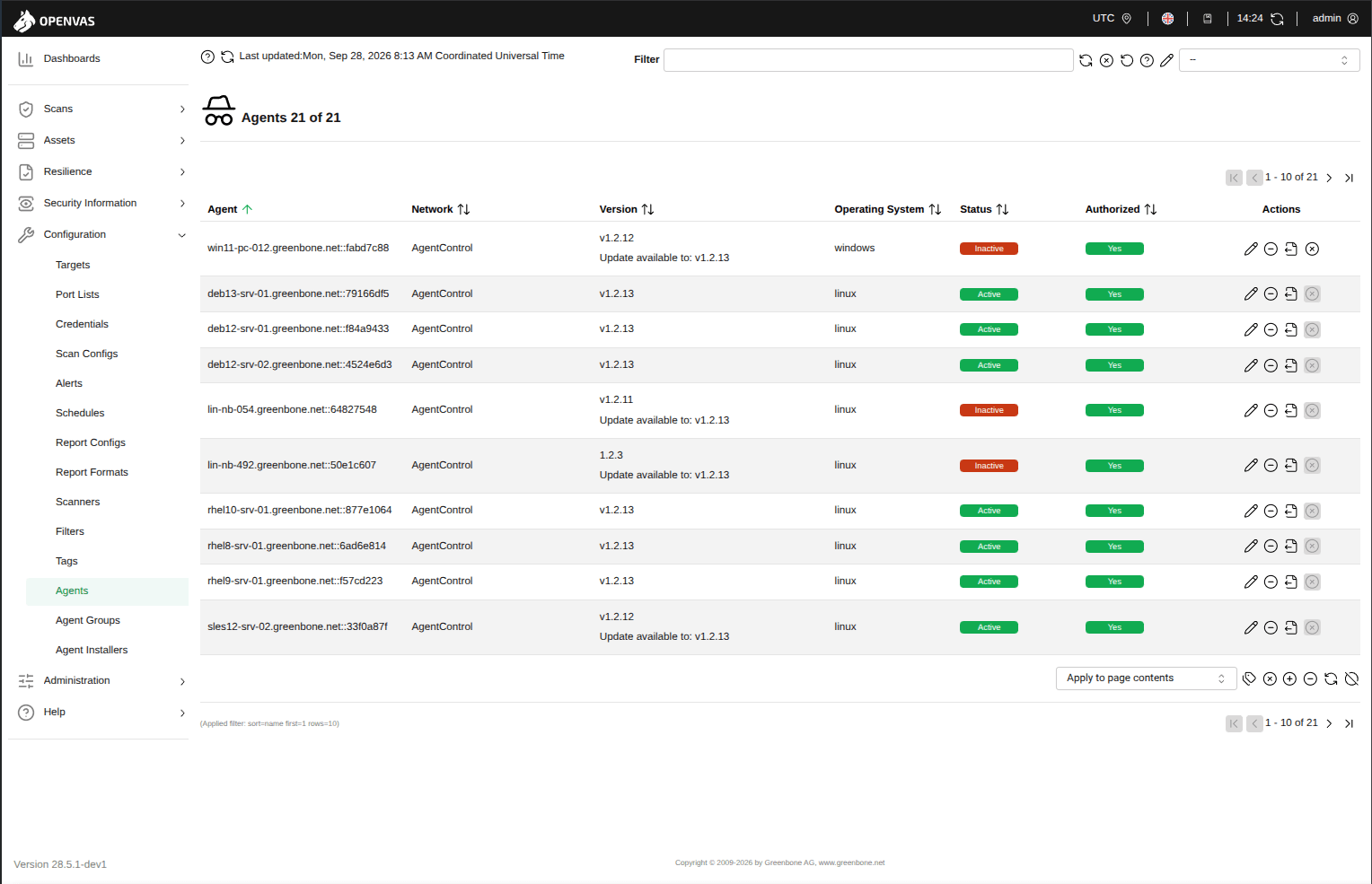

Greenbone gives you the choice: scan agentlessly, deploy agents, or combine both. You decide the best model for your infrastructure.


Different approaches cover different ground. Here’s how they compare.
| Criterion | Network Scan | SSH / SMB Auth Scan | Agent-Based Scanning |
|---|---|---|---|
| Deep local vulnerability checks | None | Full |  Extended beyond script-based checks Extended beyond script-based checks |
| Works without inbound network access | No | No | Yes |
| Scan time and reporting | Time consuming | Time consuming | Within seconds |
| Centralized credentials required | No | Yes | No |
| Works for remote-premises devices (e.g., laptops) | No | No | Yes |
| Works across network segments | Complex setup required | Complex setup required | Yes |
Greenbone is designed around your operational reality. If compliance constraints, PAM policies, or network topology drive your choices, we have a solution for your needs.


Already using CyberArk or another PAM solution for remote authenticated scans? We support that too. Agents are an option, not a requirement.
Greenbone has long supported SSH and SMB remote access for credentialed scans. Agents take that capability further: delivering endpoint visibility with less friction, less risk, and more frequency.


Agent-based scanning solves real operational challenges that traditional agentless credentialed scans weren’t designed for.


Talk to our team and find out which scanning model fits your infrastructure.
Agent-based scanning is engineered for low resource consumption on production IT systems: under 100 MB disk space, minimal CPU, and a lean memory footprint.


Agent-based scanning is available to all customers on the new licensing model at no additional charge. Agents count toward your existing asset quota: even if an endpoint is also detected in a network scan, it counts as a single asset. Other vendors charge separately for agent deployments. We don’t.

Technology Preview: Agent-based scanning is an early-access capability for evaluation ahead of general availability and is not intended for production use. You can find the full definition in the manual, and you are also pointed to it when you enable the feature in the GOS menu. The feature is part of OPENVAS SCAN and will also be included in OPENVAS SECURITY INTELLIGENCE once that product becomes available. It is not a separate product and can be enabled directly from your GOS menu.
Do I have to use agents, or can I keep using network-based scanning?
Agents are an option, not a requirement. Agent-based scanning is optional: if traditional credentialed scanning works for you, including environments where PAM policies restrict agent deployment, you can continue exactly as before. Mixed approaches also work within a single OPENVAS SCAN instance.
What's the difference between an agent and an SSH/SMB authenticated scan?
Both produce the same class of local endpoint vulnerability data. The key differences are that agent-based scanning runs continuously and reports faster than a scheduled scan, agents don’t require centralized credential storage, and they initiate outbound connections rather than waiting for an inbound scan session, making them significantly simpler to deploy in restricted environments.
How does agent counting work in the license?
Each agent-managed endpoint counts as a single asset against your license quota. If the same endpoint is also discovered by a network scan, it still counts as one asset. There are no additional per-agent fees on top of your existing subscription.
Does the agent require outbound internet access or just access to OPENVAS SCAN?
Agents call back to your OPENVAS SCAN instance, not to an external Greenbone cloud endpoint. This means the agent only needs outbound network access to your internal OPENVAS SCAN deployment, making it more compatible with typical firewall configurations.
What platforms are supported today?
Windows 10, Windows 11, Server 2016, Server 2019, Server 2022, and Server 2025, and major Linux distributions including Ubuntu 22.04, 24.04, and 26.04 LTS, Debian 11, 12, and 13, RHEL 8, 9, and 10, and SUSE Linux Enterprise Server 15 and 16.
Does agent-based scanning cover the same products as an authenticated scan?
Agent-based scanning detects all applications on the device, more than an authenticated scan would, regardless of whether a vulnerability is present. That said, an authenticated scan will still detect more vulnerabilities than the agent, since some Enterprise feed content is exempted from agent-based checks: for example, products an agent is unlikely to be installed on, such as switches and routers, as well as tests meant to be carried out remotely over the network, such as non-credentialed banner-based tests and active checks.
Talk to our team to see how agent-based scanning integrates with your existing vulnerability management setup: agentlessly, with agents, or both.
Already a Greenbone customer? Enable the feature directly from your GOS menu.